
Depose meaning is a common search because the word appears in news reports, legal documents, history books, and courtroom discussions. Many people see phrases like “the king was deposed” or “the witness will be deposed” and wonder what the word actually means. Although it looks complicated, its meaning is easy to understand once you know the context.
The word depose has more than one meaning. It can describe removing someone from a position of power, or it can refer to giving sworn testimony in a legal case. Understanding these different meanings helps you use the word correctly in conversations, writing, and professional settings.
Quick Answer:
Depose means to remove someone from a position of authority or to give sworn testimony under oath before a trial, depending on the context.
What Does Depose Mean?
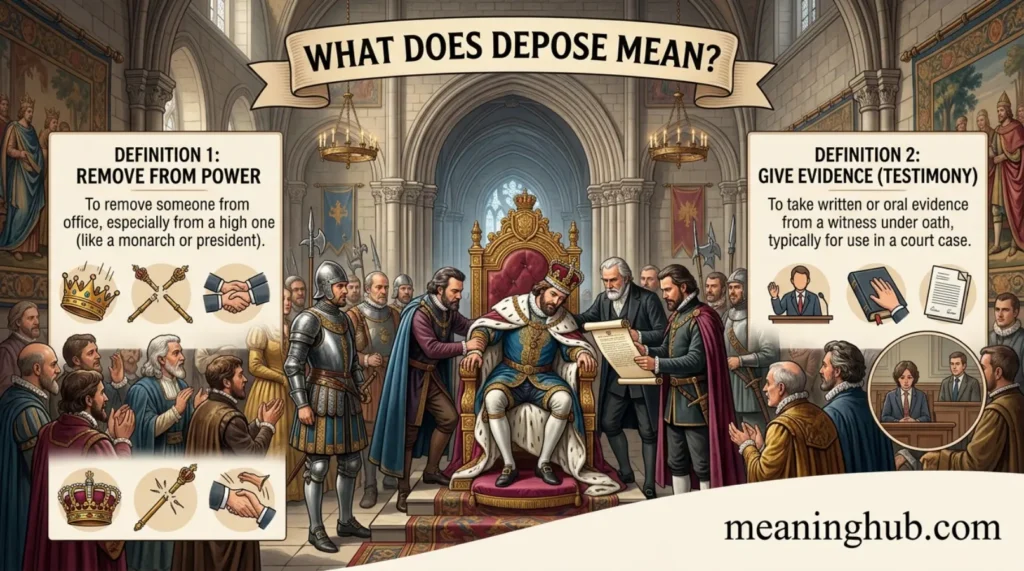
The word depose has two main meanings.
1. To Remove Someone From Power
This is the most common historical and political meaning.
When a ruler, president, king, queen, or leader is deposed, they are removed from their position of authority. This usually happens through political action, revolution, military intervention, or legal procedures.
Examples:
- The king was deposed after the revolution.
- The dictator was deposed by the military.
- Citizens demanded that the corrupt leader be deposed.
2. To Give Testimony Under Oath
In legal situations, depose means giving official testimony under oath before a court trial. The person answering questions is said to be deposed, and the process is called a deposition.
Examples:
- The witness will be deposed next week.
- The lawyer plans to depose several experts.
- She was deposed for three hours during the investigation.
Depose Definition
The dictionary definition of depose is:
- To remove someone from an office, throne, or position of authority.
- To testify or give evidence under oath outside the courtroom.
Both meanings are correct. The surrounding sentence tells you which meaning is intended.
Depose Pronunciation
Depose is pronounced:
di-POHZ
Phonetic spelling:
/dɪˈpoʊz/
The stress falls on the second syllable.
Parts of Speech
| Word | Part of Speech | Meaning |
|---|---|---|
| Depose | Verb | Remove from power or question under oath |
| Deposed | Verb (Past) | Removed from office or questioned officially |
| Deposing | Verb (Present Participle) | The act of removing or questioning |
| Deposition | Noun | Sworn testimony given before trial |
Where Is Depose Commonly Used?
The word appears in several fields.
Politics
Political news often uses depose when discussing leaders who lose power.
Example:
- Protesters hoped to depose the president.
History
History books frequently describe kings and queens being deposed.
Example:
- The emperor was deposed after losing the war.
Law
Lawyers use depose during legal investigations before a case reaches court.
Example:
- The attorney will depose the witness tomorrow.
Journalism
News organizations use the word when reporting political or legal events.
Example:
- Reports confirmed that the military had deposed the ruler.
Depose in Legal Terms
Legal professionals use depose differently from historians.
A deposition is a formal interview where a witness answers questions while under oath. Lawyers from both sides ask questions, and everything is recorded.
The purpose of a deposition is to:
- Gather evidence
- Understand what witnesses know
- Prepare for trial
- Identify inconsistencies
Depositions usually happen in a lawyer’s office rather than inside a courtroom.
Depose in Politics
When discussing governments, depose means forcing a leader out of office.
This can happen because of:
- Elections
- Impeachment
- Revolutions
- Military coups
- Constitutional decisions
Example:
“The unpopular ruler was eventually deposed after months of protests.”
Difference Between Depose and Deposition
Many learners confuse these words.
| Word | Meaning |
|---|---|
| Depose | The action of removing someone from power or questioning under oath |
| Deposition | The legal testimony given under oath before trial |
Example:
- The lawyer will depose the witness.
- The witness completed a five-hour deposition.
Depose vs Dispose
These words sound similar but have completely different meanings.
| Depose | Dispose |
|---|---|
| Remove from power | Get rid of something |
| Give sworn testimony | Arrange or manage something |
| Used in politics and law | Used in everyday English |
Examples:
Correct:
- The king was deposed.
Correct:
- Please dispose of the trash.
Depose vs Remove
Although both words involve taking someone away from a position, depose is much stronger.
| Remove | Depose |
|---|---|
| General action | Official removal from authority |
| Everyday situations | Politics and law |
| Can apply to objects or people | Usually applies to rulers or officials |
Example:
- The company removed the manager.
- The revolution deposed the king.
Origin of the Word Depose
The word comes from the Latin word deponere, meaning “to put down.”
Later it entered Old French before becoming part of English.
Originally, it referred to putting someone down from a high position, which explains why it now means removing someone from authority.
Its legal meaning developed over time because testimony is formally “laid down” under oath.
Real-Life Examples of Depose
Friendly Conversation
“My history teacher explained how several kings were deposed during the Middle Ages.”
Casual Discussion
“I didn’t know lawyers could depose witnesses before a trial.”
News Example
“The military announced that it had deposed the president.”
Legal Context
“The witness agreed to be deposed next Monday.”
Educational Context
“The textbook describes how the emperor was deposed after the rebellion.”
Workplace Conversation
“The legal team plans to depose former employees as part of the investigation.”
Is Depose a Positive or Negative Word?
The word itself is neutral.
Its emotional meaning depends on the situation.
Positive examples:
- A corrupt dictator was deposed.
- Citizens celebrated after the ruler was deposed.
Negative examples:
- A respected leader was unfairly deposed.
- The king was violently deposed.
In legal settings, depose carries no positive or negative emotion. It simply describes a legal process.
Common Mistakes
People often misunderstand the word.
Mistake
Thinking it only relates to kings.
Reality:
It also applies to presidents, judges, officials, and legal testimony.
Mistake
Confusing it with dispose.
These words have different meanings.
Mistake
Using it for ordinary job changes.
Incorrect:
- My boss was deposed yesterday.
Better:
- My boss was removed from the position.
Unless the removal involved an official leadership role, “removed” is usually the better choice.
Similar Words
Here are some words with related meanings.
| Word | Meaning |
|---|---|
| Remove | Take away from a position |
| Oust | Force someone out of office |
| Dethrone | Remove a king or queen |
| Impeach | Officially charge a public official |
| Testify | Give evidence in court |
| Question | Ask for information |
| Deposition | Sworn legal testimony |
When Should You Use Depose?
Use depose when discussing:
- Historical rulers
- Political leaders
- Government changes
- Legal investigations
- Court procedures
- Witness testimony
Avoid using it for ordinary everyday situations unless official authority or legal testimony is involved.
Why Is This Word Important?
Understanding depose improves reading comprehension because the word appears in:
- Newspapers
- Court reports
- Political discussions
- History books
- College textbooks
- Government documents
Knowing both meanings prevents confusion when reading articles or watching the news.
Quick Summary Table
| Topic | Meaning |
|---|---|
| Primary Meaning | Remove from power |
| Legal Meaning | Give sworn testimony |
| Part of Speech | Verb |
| Related Noun | Deposition |
| Pronunciation | di-POHZ |
| Common Fields | Law, politics, history, journalism |
FAQs
What does depose mean in simple words?
Depose means removing someone from an important position of power or giving sworn testimony in a legal case.
Is depose only used in law?
No. It is also widely used in politics, history, and journalism.
What is the difference between depose and deposition?
Depose is the action, while a deposition is the official testimony given under oath.
Is depose a negative word?
Not necessarily. It is generally neutral, although the situation may be viewed as positive or negative depending on the context.
Can a president be deposed?
Yes. In political discussions, a president or other leader may be described as deposed if they are removed from power through official or forceful means.
How do you remember the meaning of depose?
Think of depose as “putting someone down from a position of power” or “giving sworn evidence before a trial.”
Conclusion
Understanding depose meaning is easier once you recognize its two main uses. In politics and history, depose means removing a ruler or official from power. In law, it means giving sworn testimony during a deposition before a trial. Although the same word has different meanings, the surrounding context makes its purpose clear.
Learning this word helps you understand news articles, legal documents, historical events, and professional writing with greater confidence. By using depose correctly, you can communicate more accurately and avoid confusing it with similar words like dispose or remove.

Alexander Ford is a passionate writer who specializes in modern text slang, internet culture, and digital communication trends. He is known for his simple, engaging, and reader-friendly writing style that makes online language easy to understand. With a love for research and creativity, Alexander enjoys helping readers stay updated with the latest social media expressions and texting terms.