No Contest Meaning is a phrase that many people search after hearing it in court cases, legal news, sports, or everyday conversations. At first glance, it may sound like someone is giving up or refusing to compete. However, the meaning changes depending on the situation. In legal settings, “no contest” has a very specific definition. In casual conversations, it simply means there is no competition because one option is clearly better than another.
Understanding this phrase can help you avoid confusion, especially when reading news articles, watching courtroom dramas, or talking with others online. This guide explains the meaning in simple English with real-life examples, common uses, and practical tips.
Quick Answer:
No contest means a person does not challenge or dispute something. In court, it refers to a plea where the defendant does not admit guilt but also does not fight the charges. In everyday language, it means the winner or better choice is obvious.
What Does No Contest Mean?
The phrase no contest has two common meanings.
Legal Meaning
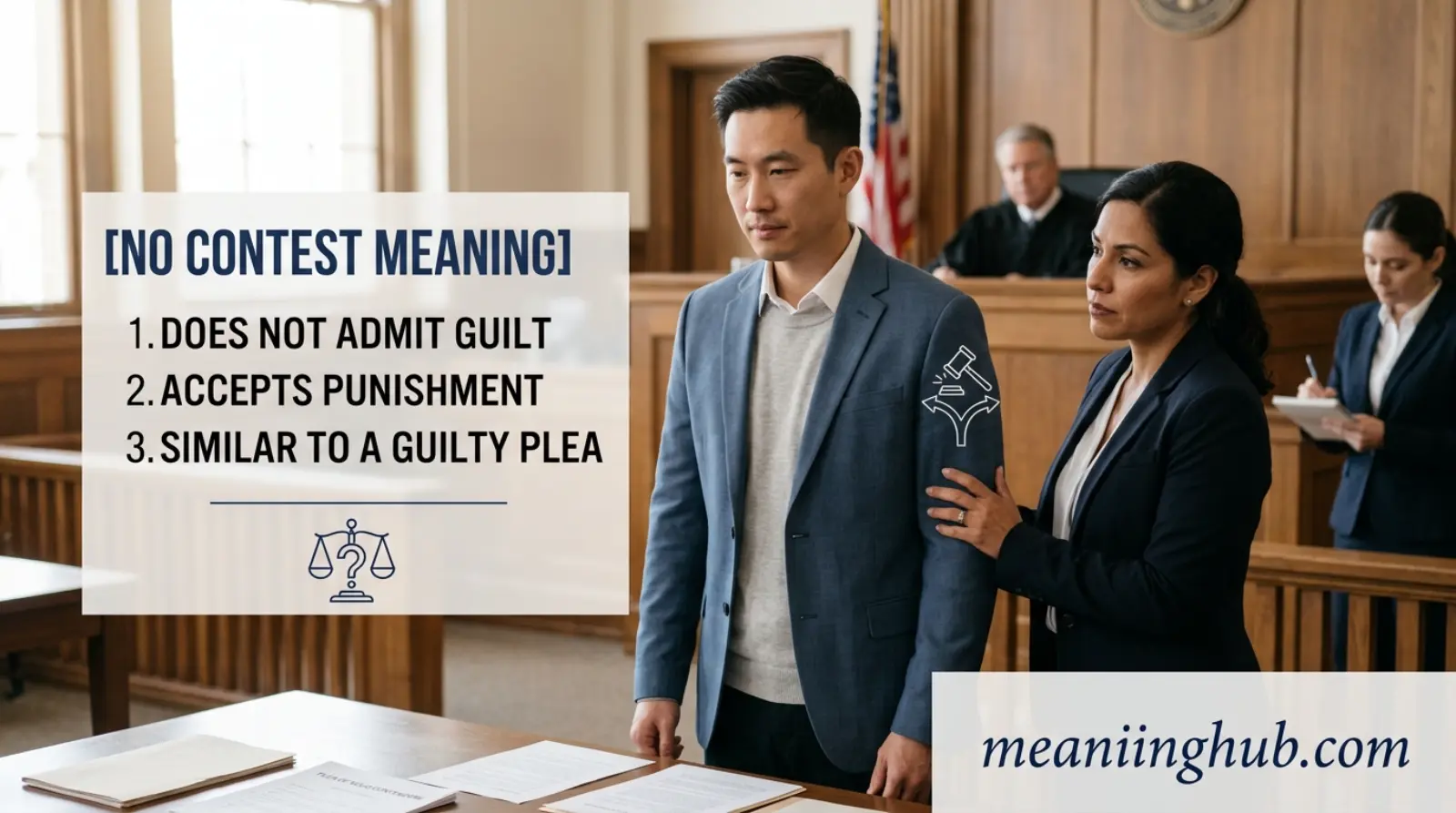
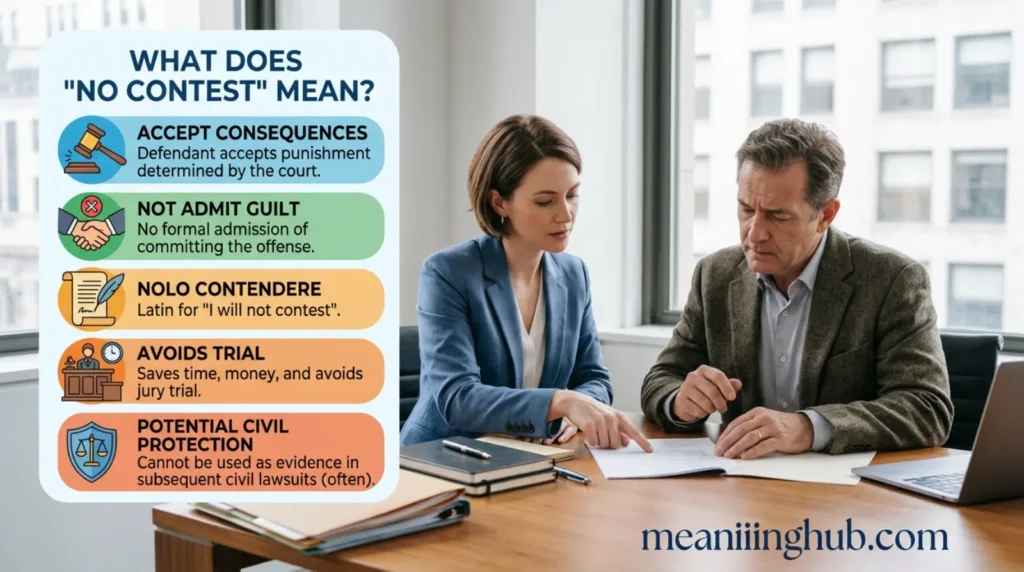
In law, a no contest plea, also known as nolo contendere, means the defendant does not admit guilt but accepts the court’s punishment without arguing against the charges.
The court usually treats a no contest plea much like a guilty plea during sentencing. However, it may have different effects in future civil lawsuits depending on local laws.
Everyday Meaning
In daily conversations, no contest means there is no real competition because one person, team, or option is clearly superior.
Example:
- Pizza or plain crackers? Pizza wins—no contest.
- She was the best singer in the competition. It was no contest.
No Contest Full Form
Unlike internet abbreviations, no contest does not have a full form.
Instead, it is a complete English phrase.
In legal language, the official Latin term is nolo contendere, which translates to I do not wish to contest.
No Contest Definition
Here is a simple definition:
No contest means choosing not to argue, dispute, or challenge something. In legal situations, it is a plea that accepts punishment without admitting guilt. In casual conversations, it means one choice is obviously better than the others.
Is No Contest Rude, Offensive, or Neutral?
The phrase is generally neutral.
It is not considered offensive or rude.
Its tone depends on how it is used.
| Situation | Tone |
|---|---|
| Courtroom | Formal and legal |
| Sports discussion | Neutral |
| Friendly debate | Casual |
| Social media | Informal |
| Comparing products | Neutral |
Sometimes people may feel insulted if you say “it’s no contest” because it suggests there was never a fair competition.
Where Is No Contest Commonly Used?
You may hear this phrase in many situations.
Legal Cases
Lawyers, judges, and journalists often use no contest when discussing criminal cases.
Example:
“The defendant entered a no contest plea.”
Sports
Fans use the phrase when one team completely dominates another.
Example:
“The championship game was no contest.”
Technology
People compare phones, laptops, or software.
Example:
“Between these two cameras, the newer model is no contest.”
Food
Friends often compare favorite meals.
Example:
“Chocolate cake versus plain bread? No contest.”
Social Media
People use it to express a clear preference.
Example:
“Summer vacations beat winter vacations. No contest.”
Real-Life Examples of No Contest
Here are examples in different situations.
Friendly Conversation
Friend A: Which movie should we watch?
Friend B: The new action movie. No contest.
Family Discussion
Dad: Which restaurant do you prefer?
Son: The Italian place. No contest.
Sports
“Our team won 5–0. It was no contest.”
Work
“This software finishes the job twice as fast. It’s no contest.”
Shopping
“The second laptop offers better value. No contest.”
Origin and Background of No Contest
The phrase became popular through the legal system.
The legal plea nolo contendere comes from Latin and has been used for centuries. Courts adopted the English expression no contest because it is easier to understand.
Outside the courtroom, people began using the phrase to describe situations where one side is clearly better than another. Today, it appears in sports, business, entertainment, reviews, and everyday conversations.
No Contest in Law Explained
Many people confuse a no contest plea with a guilty plea.
Here is the difference.
| Guilty Plea | No Contest Plea |
|---|---|
| Admits guilt | Does not admit guilt |
| Accepts punishment | Accepts punishment |
| Can sometimes affect civil cases differently | May reduce the impact in some civil cases depending on local law |
| Ends the criminal case | Ends the criminal case |
Always remember that the legal effect of a no contest plea varies by country and state.
Comparison with Similar Terms
| Term | Meaning | Common Use |
|---|---|---|
| No Contest | No challenge or obvious winner | Law and everyday speech |
| Guilty | Admits responsibility | Court |
| Innocent | Not responsible | Court |
| Walkover | Easy victory because of little competition | Sports |
| Unopposed | No challenger | Elections and competitions |
Why People Use No Contest
People like this phrase because it is simple and direct.
Common reasons include:
- It quickly shows there is an obvious winner.
- It saves time during conversations.
- It makes comparisons easier.
- It is widely understood.
- It works in both formal and informal situations.
When Should You Avoid Using No Contest?
Although the phrase is usually harmless, there are times when you should avoid it.
Do not use it:
- When comparing someone’s personal achievements.
- During sensitive discussions.
- If both sides deserve equal respect.
- In professional feedback where diplomacy matters.
For example, saying, “Your presentation versus mine? No contest,” may sound disrespectful.
Polite Alternatives
If you want a softer expression, try these alternatives.
- I prefer this one.
- This seems like the stronger option.
- In my opinion, this is better.
- This choice fits our needs best.
- I think this one has the advantage.
These phrases sound more respectful during professional conversations.
Why Context Matters
The meaning of no contest changes depending on where you hear it.
In Court
It refers to a legal plea.
Among Friends
It expresses a strong opinion.
In Sports
It describes a one-sided match.
In Product Reviews
It highlights an obvious winner.
Understanding the setting helps you interpret the phrase correctly.
Impact of Using No Contest in Communication
Using this phrase can make conversations more effective because it clearly communicates confidence.
Benefits include:
- Easy to understand.
- Short and memorable.
- Common in spoken English.
- Useful for comparisons.
Possible drawbacks include:
- May sound dismissive.
- Can offend someone if used carelessly.
- May oversimplify complex situations.
Is No Contest Safe for Social Media?
Yes.
The phrase is completely safe for social media platforms like Facebook, Instagram, X, TikTok, and Reddit.
People often use it when sharing opinions about:
- Movies
- Music
- Sports
- Food
- Travel
- Technology
- Fashion
Example:
“Coffee over energy drinks. No contest.”
Real-Life Examples in Different Contexts
Friendly
“I’d choose burgers over hot dogs. No contest.”
Casual
“This vacation was the best we’ve ever had. No contest.”
Argumentative
“You think that player is better? For me, it’s no contest.”
Gaming
“Our squad dominated the match. It was no contest.”
Social Media
“Beach sunsets are better than city skylines. No contest.”
Workplace
“After comparing all three proposals, this one is the best. No contest.”
Common Mistakes
Many people misunderstand the phrase.
Here are some common mistakes.
Thinking It Means Giving Up
Not always. In everyday English, it usually means the winner is obvious.
Assuming It Always Means Guilty
A no contest plea is not exactly the same as admitting guilt.
Using It During Sensitive Conversations
Doing so may sound rude or dismissive.
Related Keywords
People also search for:
- No contest full form
- No contest meaning slang
- What does no contest stand for
- No contest legal meaning
- No contest plea meaning
- Nolo contendere meaning
- No contest definition
- Difference between guilty and no contest
FAQs
What does no contest mean?
It means not challenging or disputing something. In everyday speech, it also means one choice is clearly better than another.
Does no contest mean guilty?
Not exactly. A no contest plea does not admit guilt, but the court generally treats it similarly to a guilty plea for sentencing.
Is no contest a slang term?
No. It is a standard English phrase commonly used in legal and everyday language.
What does no contest stand for?
It does not stand for anything because it is not an abbreviation. It is a complete phrase.
Can I use no contest in everyday conversations?
Yes. It is commonly used when one option is obviously better than another.
Is no contest always about court cases?
No. Although it has an important legal meaning, people also use it in sports, reviews, social media, and daily conversations.
Conclusion
No Contest Meaning is simple once you understand the context. In legal settings, it refers to a plea where someone accepts the court’s decision without admitting guilt. In everyday conversations, it means there is no real competition because one option is clearly better than another.
The phrase is neutral, widely accepted, and easy to use in casual discussions, sports, product comparisons, and online conversations. Always pay attention to the situation before using it, especially in professional or sensitive discussions. Knowing the correct meaning helps you communicate more clearly and avoid misunderstandings.

Alexander Ford is a passionate writer who specializes in modern text slang, internet culture, and digital communication trends. He is known for his simple, engaging, and reader-friendly writing style that makes online language easy to understand. With a love for research and creativity, Alexander enjoys helping readers stay updated with the latest social media expressions and texting terms.