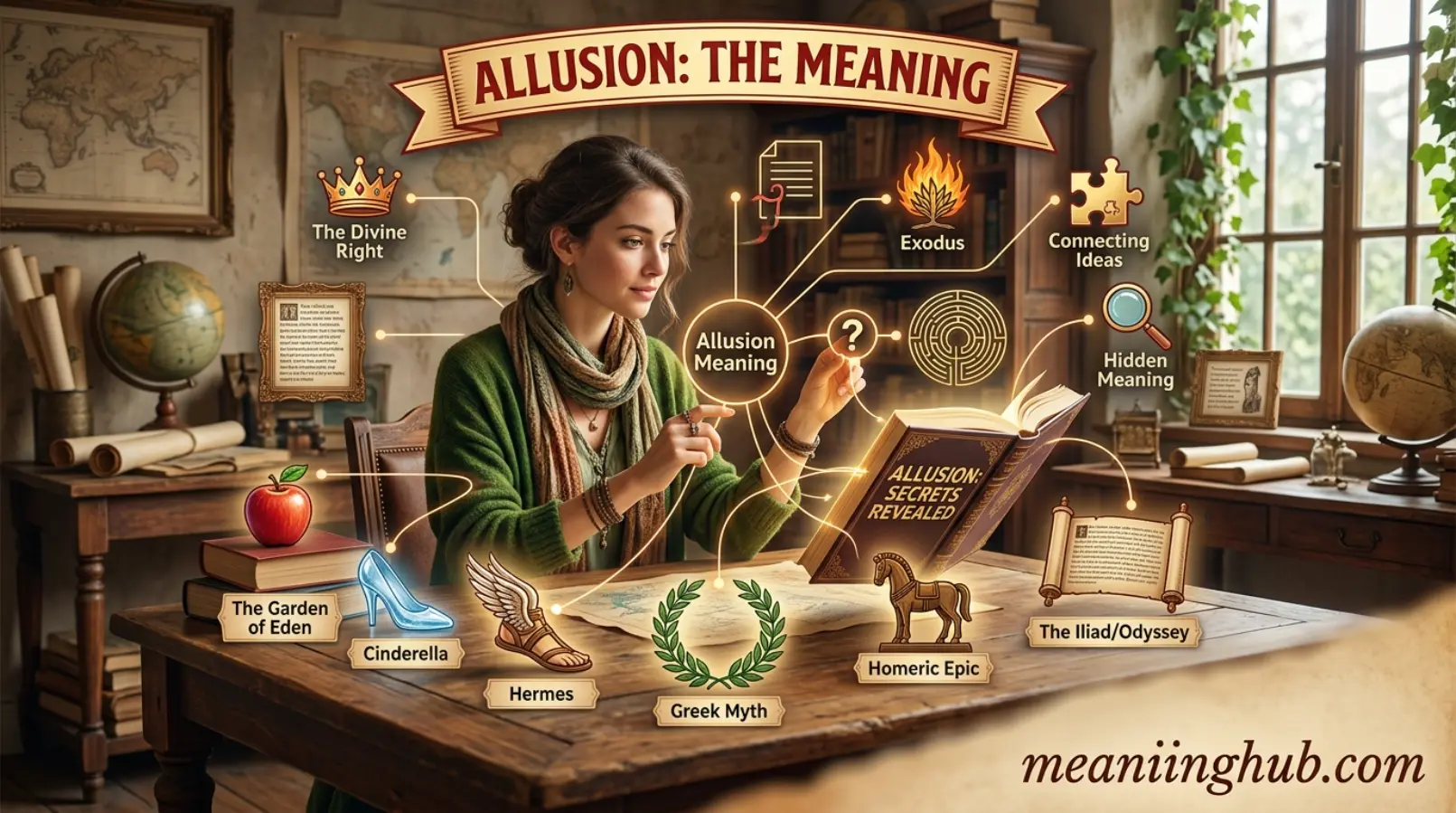
Allusion meaning is one of the most searched literary and language terms because people often come across it while reading books, studying English, or writing essays. If you’ve ever wondered why a writer mentions a famous person, historical event, movie, or myth without fully explaining it, you’ve probably encountered an allusion.
Understanding allusion can improve your reading, writing, and communication skills. It helps you recognize hidden references and deeper meanings in conversations, articles, literature, and even social media posts. Whether you’re a student, writer, or simply curious about language, learning this term makes interpreting texts much easier.
Quick Answer:
An allusion is an indirect reference to a well-known person, event, place, story, or work of art. The writer expects the audience to recognize the reference without explaining it.
What Does Allusion Mean in Text?
In text, allusion refers to a brief or indirect mention of something that is already familiar to most readers. Instead of explaining the entire background, the writer simply hints at it.
For example:
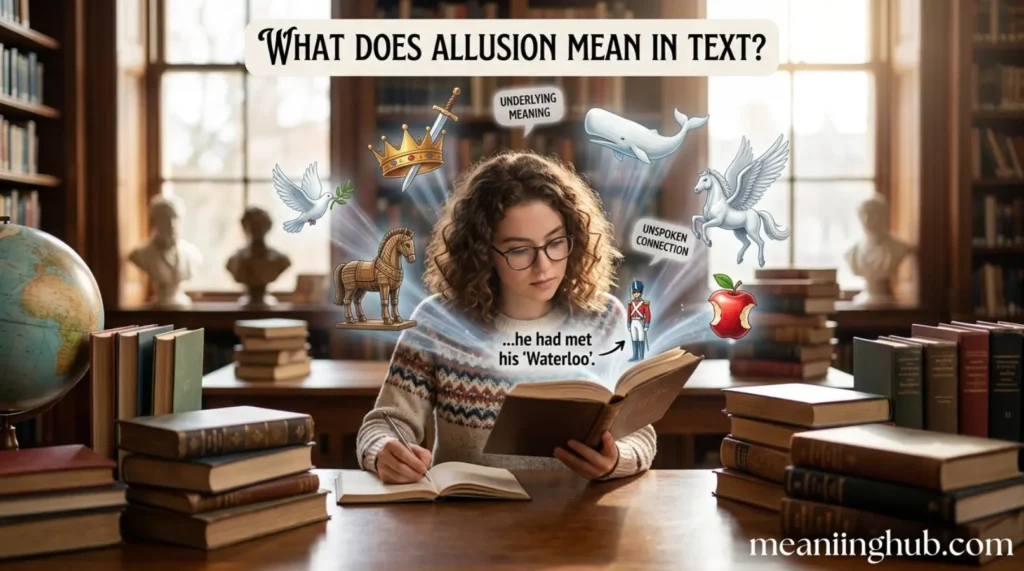
“He met his Waterloo during the final exam.”
This sentence alludes to Napoleon’s defeat at Waterloo. It suggests that the person experienced a major failure without directly explaining the historical event.
Allusions make writing richer because they allow readers to connect ideas quickly.
Key Points
- It is an indirect reference.
- The reference is usually widely known.
- It adds deeper meaning to writing.
- Readers need background knowledge to fully understand it.
Allusion Full Form / Definition
Unlike internet slang or abbreviations, allusion does not have a full form.
Definition
An allusion is a literary device in which a writer or speaker briefly refers to a famous person, event, book, myth, movie, or historical moment without explaining it directly.
Related search terms include:
- allusion full form
- allusion meaning slang
- what does allusion stand for
Since allusion is a complete English word, it does not stand for anything.
Is Allusion Rude, Offensive, or Neutral?
An allusion itself is neutral.
Whether it sounds polite or offensive depends entirely on what it refers to.
Neutral Example
“She’s as wise as Athena.”
This is a compliment.
Negative Example
“He acted like Judas.”
This compares someone to a famous betrayer, making it insulting.
Humorous Example
“My wallet is on a Titanic journey.”
This humorously suggests that your money is disappearing quickly.
Where Is Allusion Commonly Used?
Allusions appear almost everywhere in communication.
Literature
Authors use them to make stories more meaningful.
Everyday Conversations
People reference celebrities, movies, or history without lengthy explanations.
Example:
“Don’t be a Sherlock.”
This implies someone is acting like a detective.
Social Media
Memes and viral posts often depend on allusions.
Example:
“Winter is coming.”
Even outside fantasy discussions, people use it to suggest difficult times are approaching.
Speeches
Public speakers use allusions to inspire audiences by referencing historical events or famous quotes.
Real-Life Examples of Allusion
Here are several common examples.
- “She’s his Romeo.”
- “That meeting was my Waterloo.”
- “He’s no Einstein.”
- “Don’t open Pandora’s Box.”
- “He’s carrying the world like Atlas.”
- “She found her Prince Charming.”
- “This place feels like Eden.”
- “He has the patience of Job.”
Each sentence references something widely known while leaving readers to understand the deeper meaning.
Origin and Background of Allusion
The word allusion comes from the Latin word alludere, meaning “to play with” or “to refer to indirectly.”
The concept has existed for thousands of years.
Ancient Greek and Roman writers frequently used allusions to mythology and history. During the Renaissance, authors such as Shakespeare filled their works with biblical and classical references.
Today, allusions continue to appear in:
- Novels
- Poetry
- Films
- TV shows
- Speeches
- Advertising
- Internet memes
- Social media captions
Comparison with Similar Terms
Many people confuse allusion with similar literary devices.
| Term | Meaning | Example |
|---|---|---|
| Allusion | Indirect reference | “He’s an Einstein.” |
| Reference | Direct mention | “Albert Einstein discovered relativity.” |
| Analogy | Comparison for explanation | “Learning is like climbing a mountain.” |
| Metaphor | Direct comparison | “Time is money.” |
| Simile | Comparison using “like” or “as” | “Brave as a lion.” |
The biggest difference is that an allusion expects readers to recognize the hidden reference.
When to Avoid Using Allusion
Although allusions are useful, they are not always appropriate.
Avoid using them when:
- Your audience may not understand the reference.
- Writing technical or legal documents.
- Giving instructions that require complete clarity.
- Communicating with international audiences unfamiliar with the reference.
- The allusion could offend someone.
If readers miss the reference, the intended meaning may also be lost.
Polite Alternatives
Since allusion is not offensive, it usually doesn’t require replacement.
However, if a reference could seem insulting, consider using clearer language.
Instead of:
“You’re acting like Judas.”
Say:
- “You’re being dishonest.”
- “That wasn’t very trustworthy.”
- “I feel disappointed.”
These alternatives communicate the same idea more respectfully.
Why People Use Allusion
People use allusions because they make communication more engaging.
Benefits include:
- Saves words
- Creates emotional impact
- Adds humor
- Shows creativity
- Makes writing memorable
- Builds connections with readers
- Encourages deeper thinking
A simple allusion can communicate an entire story in just a few words.
Impact of Using Allusion in Communication
Using allusions effectively can strengthen communication.
Positive Effects
- Makes writing more interesting
- Demonstrates cultural knowledge
- Helps readers visualize ideas
- Creates stronger emotional responses
- Improves storytelling
Possible Drawbacks
- Some readers may miss the reference.
- Different cultures recognize different allusions.
- Overusing them can confuse audiences.
Balance is important.
Is It Safe for Social Media?
Yes.
Allusions are completely safe for social media platforms.
People frequently use references from:
- Movies
- TV shows
- Songs
- Sports
- History
- Mythology
- Books
- Viral memes
Just make sure your audience understands the reference and that it isn’t offensive.
Examples of Allusion in Different Situations
Friendly
“You’re the Sherlock of our group.”
Casual
“My room looks like a battlefield.”
Argumentative
“Don’t play the victim like Romeo.”
Gaming Context
“Our team found its Achilles’ heel.”
Social Media
“Monday feels like climbing Mount Everest.”
School Writing
“The politician met his Waterloo after the debate.”
Workplace
“Our project became a Pandora’s Box once we changed the software.”
Comparison Table of Similar Literary Terms
| Term | Meaning | Common Use |
|---|---|---|
| Allusion | Indirect reference | Literature, speeches, conversations |
| Metaphor | Direct comparison | Creative writing |
| Simile | Comparison using “like” or “as” | Descriptive writing |
| Symbolism | Object representing an idea | Literature |
| Allegory | Story with hidden meaning | Novels and fables |
Frequently Asked Questions
What is the meaning of allusion?
An allusion is an indirect reference to a famous person, event, place, story, or work that readers are expected to recognize.
Is allusion a slang word?
No. Allusion is a standard English literary term, not internet slang.
What does allusion stand for?
Allusion does not stand for anything. It is a complete English word and has no acronym or full form.
Why do writers use allusions?
Writers use allusions to make their writing more meaningful, memorable, and engaging while using fewer words.
Can allusions be offensive?
Yes, depending on the reference. An allusion comparing someone to a negative historical or fictional character may be considered insulting.
Is allusion used only in literature?
No. Allusions are common in everyday conversations, movies, speeches, advertisements, social media, and journalism.
Conclusion
Understanding allusion meaning helps you recognize the hidden references that appear in books, conversations, speeches, and online content. An allusion is an indirect mention of a well-known person, event, story, or place that adds depth and creativity to communication without lengthy explanations.
Whether you’re reading literature, writing essays, or creating engaging content, knowing how allusions work can improve both your understanding and your writing. Remember that effective allusions depend on your audience’s knowledge, so always consider context and tone before using them. When used thoughtfully, allusions make communication more memorable, expressive, and impactful.

Alexander Ford is a passionate writer who specializes in modern text slang, internet culture, and digital communication trends. He is known for his simple, engaging, and reader-friendly writing style that makes online language easy to understand. With a love for research and creativity, Alexander enjoys helping readers stay updated with the latest social media expressions and texting terms.