
Pro bono meaning is a common search because many people hear the phrase in legal news, business discussions, volunteer work, and professional services but are unsure what it actually means. Although it is often linked to lawyers, the term is also used by doctors, consultants, accountants, designers, and other professionals who donate their skills without charging a fee.
Understanding the meaning of “pro bono” helps you recognize when someone is providing professional services for the public good rather than for payment. Whether you see the phrase in a news article, on a law firm’s website, or in a job description, knowing its meaning makes it easier to understand the context.
Quick Answer:
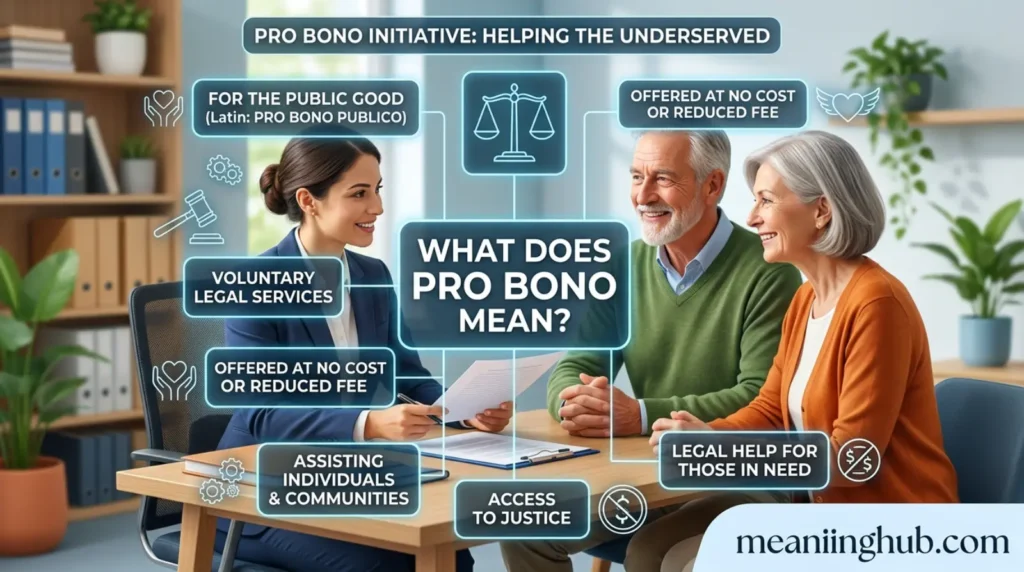
Pro bono means providing professional services free of charge for the benefit of others, especially people or organizations that cannot afford to pay. The phrase comes from the Latin expression pro bono publico, meaning “for the public good.”
What Does Pro Bono Mean?
The pro bono meaning is simple: it refers to professional work done voluntarily without payment to help individuals, charities, or communities.
The phrase is most commonly associated with lawyers who represent clients for free. However, many professionals also perform pro bono work to support nonprofit organizations, educational institutions, or people facing financial hardship.
For example:
- A lawyer represents a low-income family without charging legal fees.
- A graphic designer creates a logo for a charity for free.
- A marketing expert helps a nonprofit organization without payment.
In all of these situations, the professional donates their expertise instead of their money.
Pro Bono Full Form
Many people search for the pro bono full form, but technically, it is not an acronym.
Instead, it is a shortened version of the Latin phrase:
Pro Bono Publico
This translates to:
“For the public good.”
Today, most people simply say pro bono, and the shortened form has become widely accepted around the world.
What Does Pro Bono Stand For?
If someone asks, “What does pro bono stand for?”, the answer is:
Pro bono stands for providing professional services voluntarily and without payment for the public good.
It emphasizes helping others through professional knowledge rather than financial donations.
Is Pro Bono Rude, Offensive, or Neutral?
The term pro bono is completely neutral and respectful.
It is commonly used in:
- Law firms
- Government agencies
- Nonprofit organizations
- Universities
- Healthcare organizations
- Corporate social responsibility programs
Using the phrase shows generosity and community service rather than anything offensive.
Where Is Pro Bono Commonly Used?
The phrase appears in many professional settings.
Legal Services
This is the most common use.
Lawyers may provide free legal assistance to people who cannot afford legal representation.
Example:
“The attorney agreed to take the case pro bono.”
Healthcare
Doctors and medical specialists may volunteer their services during humanitarian missions.
Example:
“The surgeon worked pro bono at a free medical camp.”
Business Consulting
Consultants sometimes advise nonprofit organizations without charging fees.
Example:
“The consultant offered pro bono business advice.”
Graphic Design
Creative professionals often support charities with free branding or marketing.
Example:
“The designer created the charity’s website pro bono.”
Education
Teachers and tutors may provide free educational services.
Example:
“The tutor worked pro bono for underprivileged students.”
Real-Life Examples of Pro Bono Usage
Here are some natural examples.
Example 1
“Our law firm handled the case pro bono.”
Example 2
“The architect designed the community center pro bono.”
Example 3
“Several doctors volunteered pro bono after the earthquake.”
Example 4
“She provides pro bono consulting to local nonprofits.”
Example 5
“The photographer covered the charity event pro bono.”
Origin and Background of Pro Bono
The pro bono meaning comes from the Latin phrase pro bono publico, which has been used for centuries.
The phrase became especially important in the legal profession, where lawyers were encouraged to dedicate part of their careers to serving people who could not afford legal assistance.
Today, pro bono work exists in many industries. Companies often encourage employees to participate in volunteer projects using their professional skills.
Many professional organizations even recognize outstanding pro bono contributions through awards and certifications.
Why People Use the Term Pro Bono
There are many reasons professionals perform pro bono work.
To Help People in Need
Many individuals cannot afford expensive professional services.
To Support Communities
Professionals use their knowledge to strengthen local communities.
To Build Experience
Young professionals may gain valuable practical experience.
To Give Back
Many people see pro bono work as a way to contribute to society.
To Improve Professional Reputation
Organizations often appreciate businesses that actively support charitable causes.
Comparison with Similar Terms
| Term | Meaning | Paid? | Main Purpose |
|---|---|---|---|
| Pro bono | Professional services provided free of charge | No | Public good |
| Volunteer work | Helping others without professional obligation | Usually No | Community service |
| Charity | Donating money or goods | No | Financial support |
| Internship | Learning through work experience | Sometimes | Career development |
| Community service | Helping society through volunteer activities | No | Public benefit |
Although these terms are related, pro bono specifically refers to professional services rather than general volunteering.
Is Pro Bono the Same as Volunteer Work?
Not exactly.
Volunteer work can include almost any unpaid activity.
Examples include:
- Cleaning parks
- Serving food
- Organizing events
Pro bono work specifically involves using professional skills.
For example:
- Legal advice
- Medical treatment
- Accounting
- Software development
- Marketing
- Engineering
Every pro bono project is volunteer work, but not all volunteer work is pro bono.
When Should You Avoid Using Pro Bono?
Although the phrase is appropriate in professional settings, there are situations where another expression may sound more natural.
Avoid using it when:
- Talking about unpaid favors between friends.
- Describing free products or discounts.
- Referring to unpaid internships.
- Discussing personal gifts.
For instance, if your friend helps you move furniture, that is not considered pro bono work.
Polite Alternatives
Depending on the situation, you can also say:
- Free professional service
- Volunteer legal assistance
- Complimentary professional support
- Donated expertise
- Community service
- Volunteer consulting
- Free legal representation
These alternatives are especially useful when speaking to audiences unfamiliar with the Latin phrase.
Why Is Pro Bono Important?
Pro bono work benefits both professionals and communities.
Benefits include:
- Increased access to justice
- Support for nonprofit organizations
- Better healthcare access
- Stronger local communities
- Professional development
- Positive public reputation
Many organizations actively encourage employees to complete a certain number of pro bono hours each year.
Impact of Using Pro Bono in Communication
Using the term correctly communicates professionalism and social responsibility.
It also highlights that the services were donated rather than discounted.
For businesses, mentioning pro bono work can demonstrate commitment to corporate social responsibility without sounding overly promotional.
However, professionals should avoid exaggerating or using pro bono work solely for publicity, as authenticity is important.
Is Pro Bono Safe for Social Media?
Yes.
The phrase is completely safe for:
- X
- TikTok
- YouTube
Professionals frequently share pro bono projects online to inspire others, celebrate community service, or promote nonprofit initiatives.
As always, confidentiality should be respected when discussing client work.
Examples of Pro Bono in Different Contexts
Friendly Conversation
“My sister does pro bono legal work every weekend.”
Casual Workplace Discussion
“Our company offers pro bono consulting to local charities.”
Professional Context
“The accounting firm completed the financial audit pro bono.”
Social Media Post
“Proud to volunteer my design skills pro bono for a children’s charity.”
Community Announcement
“Volunteer lawyers are available for pro bono legal assistance.”
Common Misunderstandings About Pro Bono
Here are a few common myths.
Myth: Pro bono only applies to lawyers.
Reality: Many professionals provide pro bono services.
Myth: Pro bono means cheap services.
Reality: The services are completely free.
Myth: Pro bono work is low quality.
Reality: Professionals usually provide the same standard of service as paid work.
Myth: Only nonprofit organizations receive pro bono help.
Reality: Individuals, community groups, and charities may all benefit.
FAQs
What is the pro bono meaning?
Pro bono means providing professional services free of charge for the public good.
What does pro bono stand for?
It comes from the Latin phrase pro bono publico, meaning “for the public good.”
Is pro bono only for lawyers?
No. Doctors, accountants, consultants, engineers, designers, and many other professionals also perform pro bono work.
Is pro bono the same as volunteering?
Not exactly. Pro bono specifically refers to unpaid professional services, while volunteering includes many other unpaid activities.
Is pro bono work legally binding?
Yes. In professional settings, pro bono services generally follow the same ethical and legal standards as paid services.
Can businesses provide pro bono services?
Absolutely. Many companies encourage employees to contribute professional skills to nonprofit organizations and community projects.
Conclusion
Understanding the pro bono meaning helps you recognize an important concept in professional and community life. The phrase refers to providing professional services free of charge for the public good and is most often associated with lawyers, although many other professionals also participate in pro bono work.
Whether you encounter the term in legal news, business, healthcare, education, or nonprofit organizations, it always reflects the idea of using professional expertise to help others without expecting payment. By understanding its meaning, origin, and proper usage, you can confidently recognize and use the term in both professional and everyday conversations.

Alexander Ford is a passionate writer who specializes in modern text slang, internet culture, and digital communication trends. He is known for his simple, engaging, and reader-friendly writing style that makes online language easy to understand. With a love for research and creativity, Alexander enjoys helping readers stay updated with the latest social media expressions and texting terms.