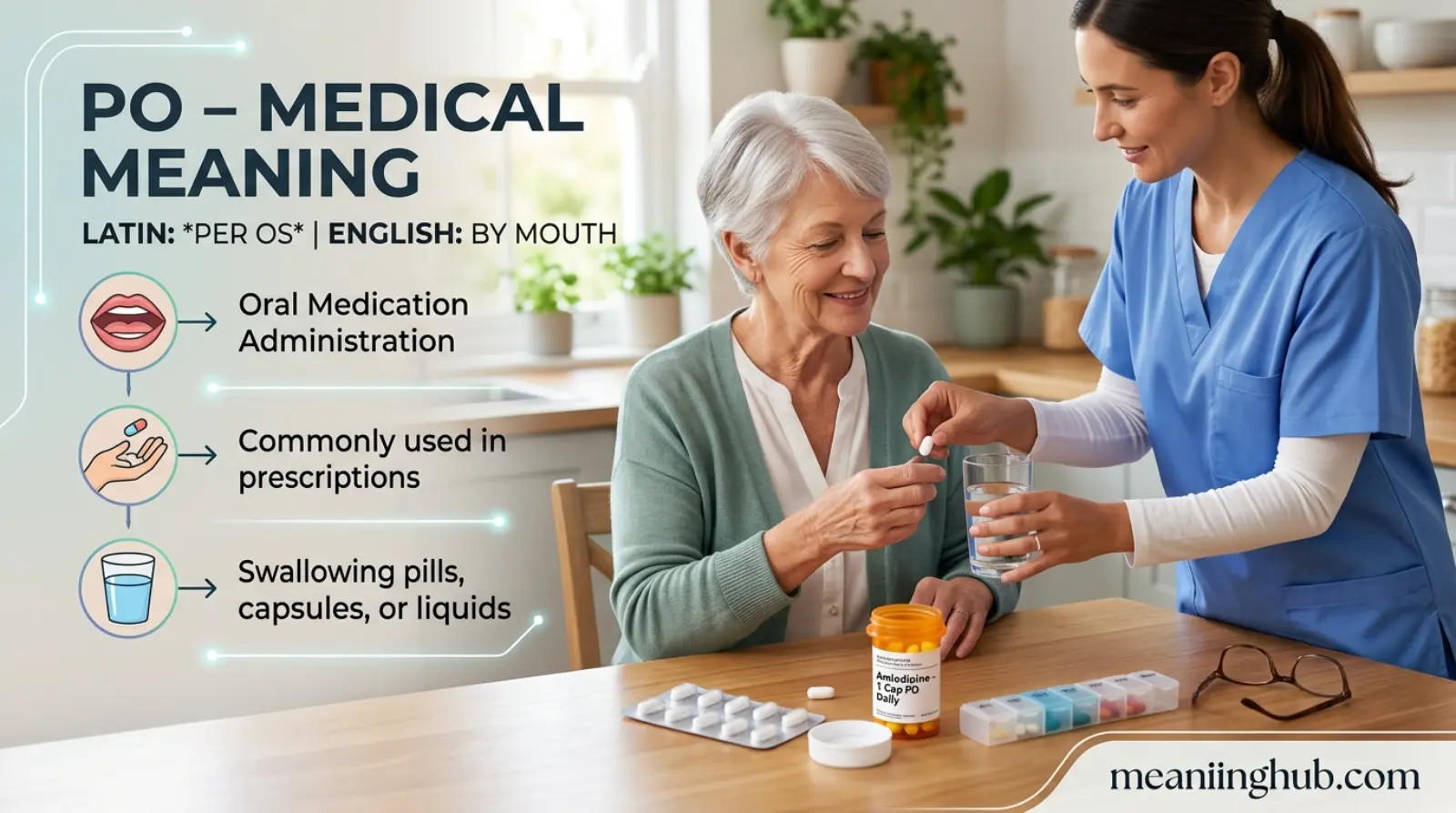
PO meaning medical is one of the most common questions people ask after reading a prescription, hospital discharge papers, or medication instructions. Medical abbreviations can be confusing, especially if you are unfamiliar with healthcare terminology. Seeing “PO” written beside a medicine can leave many patients wondering what it means and how they should take their medication.
Doctors, nurses, pharmacists, and other healthcare professionals use abbreviations to save time and make medical documentation more efficient. However, understanding these abbreviations is important because they directly affect how medications should be taken.
In this guide, you’ll learn the complete meaning of PO in medical terms, where it is commonly used, examples from real-life healthcare settings, its origin, comparisons with other medical abbreviations, and important safety tips.
Quick Answer:
PO meaning medical refers to the Latin phrase “per os,” which means “by mouth” or “orally.” When a prescription says a medicine should be taken PO, it means you should swallow the medication through your mouth unless your healthcare provider gives different instructions.
What Does PO Mean in Medical?
In medical terminology, PO means “per os,” a Latin phrase that translates to “through the mouth” or “by mouth.”
Healthcare professionals use this abbreviation to indicate the route by which a medication should be administered.
For example:
- Take one tablet PO twice daily.
- Antibiotic 500 mg PO every 8 hours.
- Pain medication PO after meals.
In each example, the medicine should be swallowed through the mouth.
Unlike injections or intravenous medications, PO medications pass through the digestive system before entering the bloodstream.
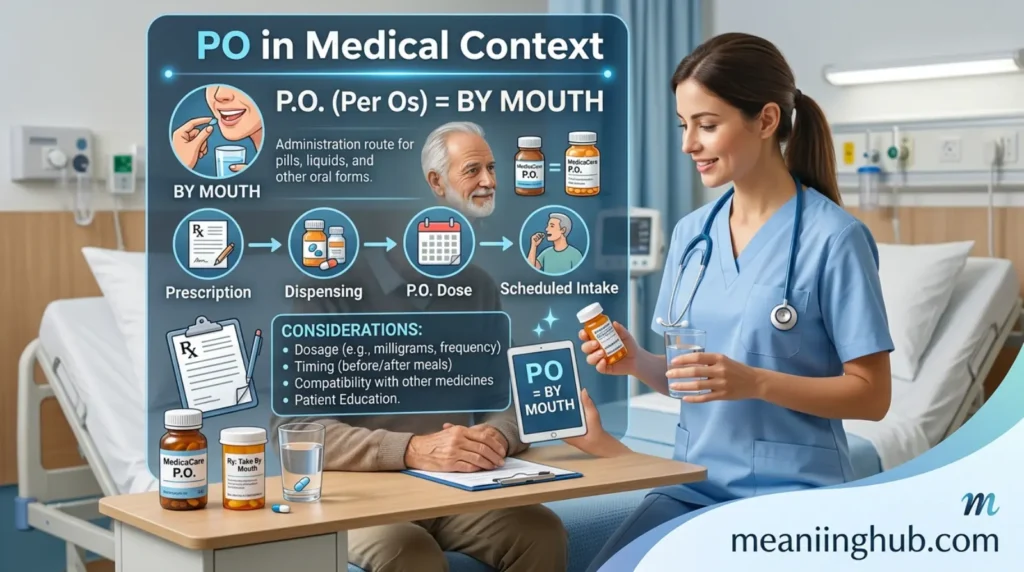
PO Full Form in Medical
The PO full form in medical language is:
Per Os
Latin Translation:
- Per = Through
- Os = Mouth
Therefore, Per Os simply means through the mouth.
Although modern medicine increasingly uses plain English instructions such as “Take by mouth,” many hospitals and healthcare providers still use PO in prescriptions and clinical documentation.
What Does PO Stand For?
Many people search:
- What does PO stand for?
- PO meaning slang
- PO abbreviation medical
- PO full form prescription
The answer is straightforward.
| Abbreviation | Full Form | Meaning |
|---|---|---|
| PO | Per Os | By mouth or orally |
It does not refer to a disease or medical condition. Instead, it tells patients how to take a medication.
How Is PO Used in Prescriptions?
Doctors frequently include PO in prescriptions because the route of administration is essential.
A prescription may look like this:
Amoxicillin 500 mg PO every 8 hours
This means:
- Medication: Amoxicillin
- Dose: 500 mg
- Route: By mouth
- Frequency: Every 8 hours
Another example:
Ibuprofen 400 mg PO as needed
This means the medicine should be swallowed by mouth whenever required according to the doctor’s instructions.
Where Is PO Commonly Used?
PO appears in many healthcare settings, including:
- Hospital medication charts
- Prescription labels
- Pharmacy instructions
- Nursing documentation
- Electronic medical records
- Patient discharge summaries
- Emergency departments
- Clinics
- Long-term care facilities
Although patients may rarely write this abbreviation themselves, healthcare workers use it every day.
Is PO Rude, Offensive, or Neutral?
Unlike internet slang, PO in medicine is completely neutral.
It is:
- Professional
- Standardized
- Internationally recognized
- Safe to use in medical communication
Patients should never interpret PO as an offensive or emotional abbreviation.
Why Do Healthcare Professionals Use PO?
Medical professionals rely on abbreviations because they:
- Save time
- Reduce repetitive writing
- Standardize communication
- Improve workflow
- Make prescriptions easier to document
However, because some abbreviations can cause confusion, many healthcare organizations now encourage writing “by mouth” instead of PO when communicating directly with patients.
Origin and Background of PO
Medical language has deep roots in Latin.
Centuries ago, physicians across Europe communicated using Latin because it was considered the universal language of medicine.
The abbreviation PO comes from:
Per Os
Even today, many medical abbreviations originate from Latin.
Examples include:
| Abbreviation | Latin | Meaning |
|---|---|---|
| PO | Per Os | By mouth |
| PRN | Pro Re Nata | As needed |
| BID | Bis In Die | Twice daily |
| TID | Ter In Die | Three times daily |
| QID | Quater In Die | Four times daily |
Although medicine is gradually shifting toward plain English, many Latin abbreviations remain widely used.
Real-Life Examples of PO Usage
Here are practical examples that patients often encounter.
Example 1
Take 1 tablet PO daily.
Meaning:
Swallow one tablet by mouth every day.
Example 2
Vitamin D 1000 IU PO once daily
Meaning:
Take Vitamin D orally once every day.
Example 3
Paracetamol 500 mg PO every 6 hours
Meaning:
Take the medicine by mouth every six hours.
Example 4
Patient tolerating PO intake well
Meaning:
The patient is eating and drinking normally.
Example 5
Resume PO medications tomorrow
Meaning:
The patient can begin taking oral medicines again tomorrow.
PO in Hospital Notes
Doctors may also write:
- NPO
- PO tolerated
- Advance PO diet
- PO fluids encouraged
These phrases relate to eating, drinking, or taking medications by mouth.
For example:
Advance PO diet
means the patient can gradually begin eating by mouth.
PO Compared with Similar Medical Abbreviations
Many abbreviations describe different medication routes.
| Abbreviation | Full Form | Meaning |
|---|---|---|
| PO | Per Os | By mouth |
| IV | Intravenous | Into a vein |
| IM | Intramuscular | Into a muscle |
| SC | Subcutaneous | Under the skin |
| SL | Sublingual | Under the tongue |
| PR | Per Rectum | Through the rectum |
| Topical | — | Applied to the skin |
| Inhalation | — | Breathed into the lungs |
Knowing the difference helps patients take medications correctly.
Why Correct Route of Administration Matters
Taking medicine by the wrong route can reduce effectiveness or even cause harm.
For example:
- Tablets meant for swallowing should not be injected.
- Injectable medicine should never be swallowed.
- Sublingual tablets should dissolve under the tongue rather than be swallowed immediately.
Always follow your doctor’s instructions exactly.
When Should You Avoid Assuming PO Means Something Else?
Outside medicine, PO can have several meanings.
Examples include:
- Purchase Order
- Post Office
- Probation Officer
- Police Officer
- Power Output
Therefore, always consider the context.
If PO appears on a prescription or hospital document, it almost certainly means Per Os.
Why Patients Search for PO Meaning Medical
People often search this term because they:
- Received a new prescription
- Read hospital paperwork
- Saw PO in medical records
- Want to understand medication instructions
- Care for a family member
- Prepare for nursing or pharmacy studies
Understanding common abbreviations helps patients become more informed about their healthcare.
Why Doctors Still Use Medical Abbreviations
Despite recommendations for plain language, abbreviations continue to be used because they:
- Speed documentation
- Reduce paperwork
- Improve efficiency
- Are familiar to healthcare professionals
- Fit electronic medical records
However, healthcare providers increasingly explain these abbreviations to patients to reduce misunderstandings.
Is PO Safe for Social Media?
Yes.
People discussing healthcare topics online may write:
- “My prescription says PO twice daily.”
- “Doctor changed my IV medicine to PO.”
- “What does PO mean in my hospital papers?”
In these situations, PO is completely appropriate and medically accurate.
However, avoid giving or following medical advice on social media without consulting a qualified healthcare professional.
Examples of PO in Different Contexts
Friendly Conversation
“My doctor said I can switch from injections to PO medication.”
Casual Conversation
“The pharmacist explained that PO just means take it by mouth.”
Hospital Conversation
“The patient is now tolerating PO fluids.”
Medical Student Discussion
“The medication route is PO, not IV.”
Social Media Context
“My discharge papers say PO after meals. Now I know it means take it orally.”
Common Mistakes About PO
Some people mistakenly believe PO refers to:
- A medical condition
- A disease
- A laboratory test
- A diagnosis
- A specific medication
These interpretations are incorrect.
PO simply tells you how to take the medicine.
Tips for Understanding Prescription Abbreviations
Whenever you receive a prescription:
- Read the label carefully.
- Ask your pharmacist if anything is unclear.
- Confirm how often to take the medicine.
- Understand whether it should be taken with food.
- Know whether the medication is PO, topical, injectable, or another route.
Never guess the meaning of an abbreviation if you are unsure.
FAQs
What is PO meaning medical?
PO means Per Os, which translates to by mouth or orally.
What does PO stand for in prescriptions?
It stands for Per Os, indicating that the medication should be swallowed through the mouth.
Is PO the same as oral medication?
Yes. PO and oral medication both refer to medicines taken by mouth.
Why do doctors write PO instead of “by mouth”?
Medical abbreviations save time and have been used for many years in healthcare documentation.
Can PO mean something different outside medicine?
Yes. Outside healthcare, PO may mean Purchase Order, Post Office, Police Officer, or other terms depending on the context.
Is PO still commonly used?
Yes. Although some healthcare systems now prefer plain-language instructions, PO remains widely used in hospitals, pharmacies, and medical records.
Conclusion
Understanding PO meaning medical can make reading prescriptions and hospital instructions much easier. The abbreviation PO stands for Per Os, meaning by mouth or orally. It tells patients that a medication should be swallowed through the mouth rather than given by injection, through a vein, or by another route.
Knowing common medical abbreviations helps patients follow treatment instructions correctly and communicate more effectively with healthcare providers. Whenever you see PO on a prescription, medication label, or hospital record, you can confidently understand that it simply refers to taking the medicine by mouth. If you are ever uncertain about a prescription or medical abbreviation, ask your doctor or pharmacist for clarification to ensure safe and effective treatment.

Alexander Ford is a passionate writer who specializes in modern text slang, internet culture, and digital communication trends. He is known for his simple, engaging, and reader-friendly writing style that makes online language easy to understand. With a love for research and creativity, Alexander enjoys helping readers stay updated with the latest social media expressions and texting terms.