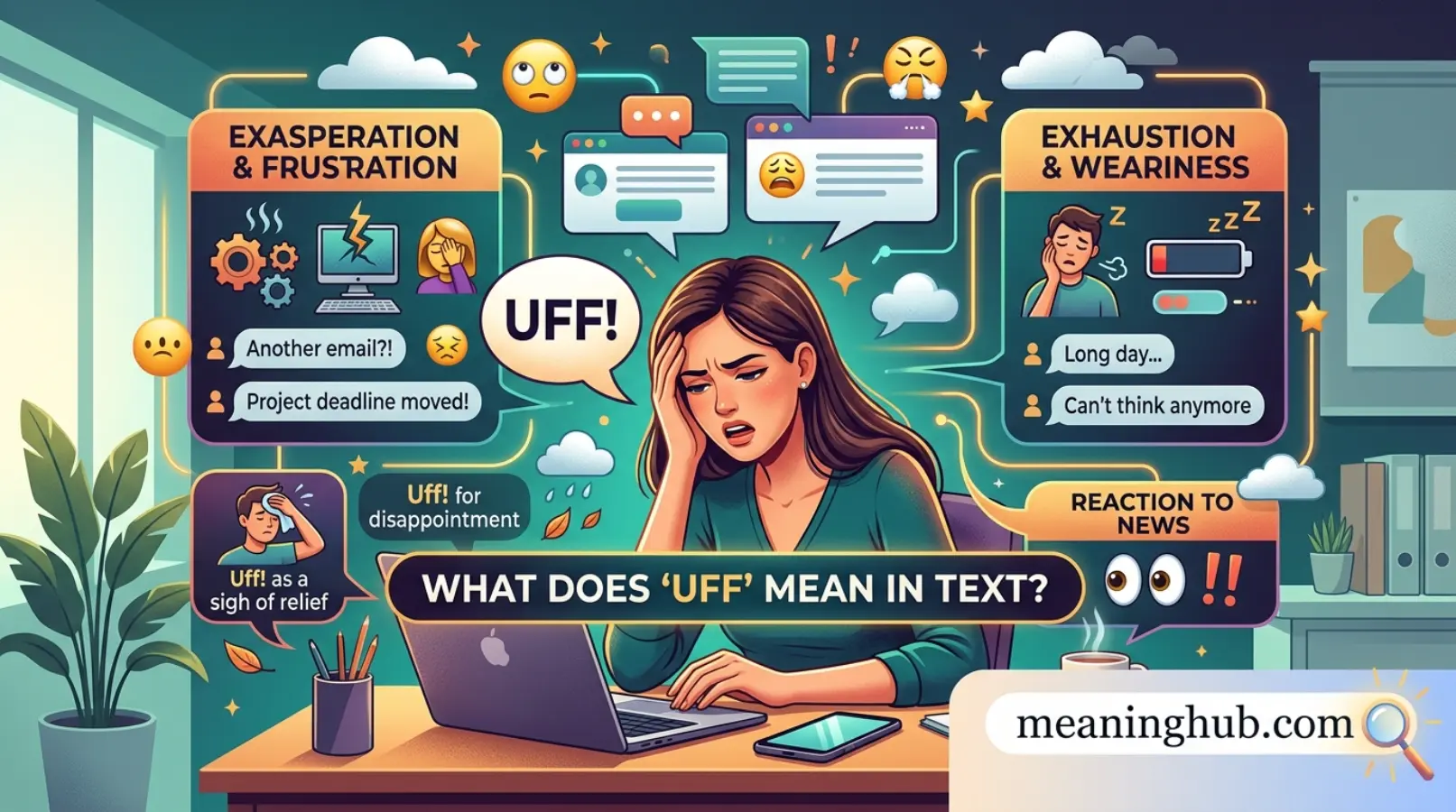
uff meaning in text is a common question people search when they see this short expression in chats, social media comments, or gaming conversations. At first glance, “uff” may look like a typo or random letters, but in reality, it carries emotion and tone that words sometimes fail to express. With the rise of texting culture, people often use short slang like “uff” to quickly show feelings such as relief, frustration, exhaustion, or even admiration.
This slang is especially popular among young users on platforms like WhatsApp, Instagram, TikTok, and online games. Instead of writing a long sentence, people simply type “uff” to express how they feel in that moment.
Quick Answer:
“Uff” is an informal expression used in text to show emotion like relief, tiredness, frustration, or emotional reaction to something intense.
What does uff mean in text?
In text messaging, “uff” is an expressive slang word used to communicate strong feelings without using full sentences. It does not have a fixed meaning like a dictionary word. Instead, its meaning changes depending on the situation.
Common meanings of “uff” include:
- Relief after stress or difficulty
- Exhaustion after physical or mental effort
- Frustration or annoyance
- Emotional reaction to something impressive or shocking
- Dramatic expression in casual conversations
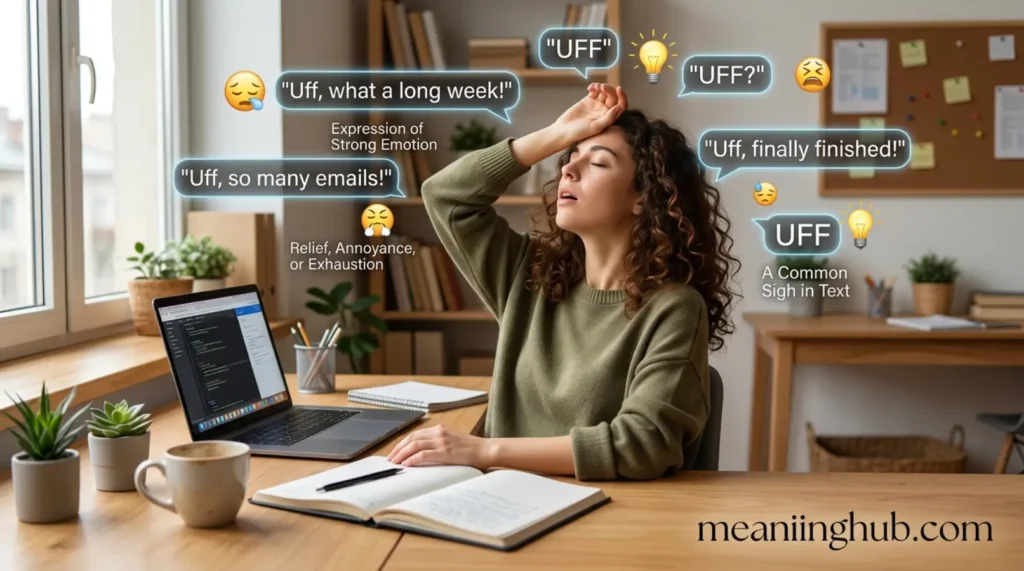
For example:
- “Uff, finally finished my homework!” (relief)
- “Uff, I’m so tired today.” (exhaustion)
- “Uff, that movie was amazing!” (admiration)
So, the meaning of “uff” in text is flexible and emotional rather than literal.
Full form / definition of the slang
“Uff” does not have an official full form. It is not an acronym. Instead, it is an onomatopoeic expression, which means it imitates a natural sound people make when reacting emotionally.
In spoken language, people often say “uff” when:
- They feel tired after hard work
- They feel overwhelmed
- They react emotionally to something intense
In texting, this sound is written as “uff” to represent that same emotional reaction.
So, instead of a full form, it is better understood as:
A short emotional sound used in text to express feelings instantly.
Is it rude, offensive, or neutral?
“Uff” is generally considered neutral, but its tone depends on context.
Neutral usage:
- “Uff, it’s so hot today.”
- “Uff, long day at work.”
Slightly emotional usage:
- “Uff, I can’t believe that happened!”
- “Uff, that was stressful.”
When it may sound negative:
If used in a sarcastic or irritated tone, it can show frustration:
- “Uff, not again…”
However, it is not offensive, abusive, or disrespectful. It is safe for casual conversations.
Where is it commonly used?
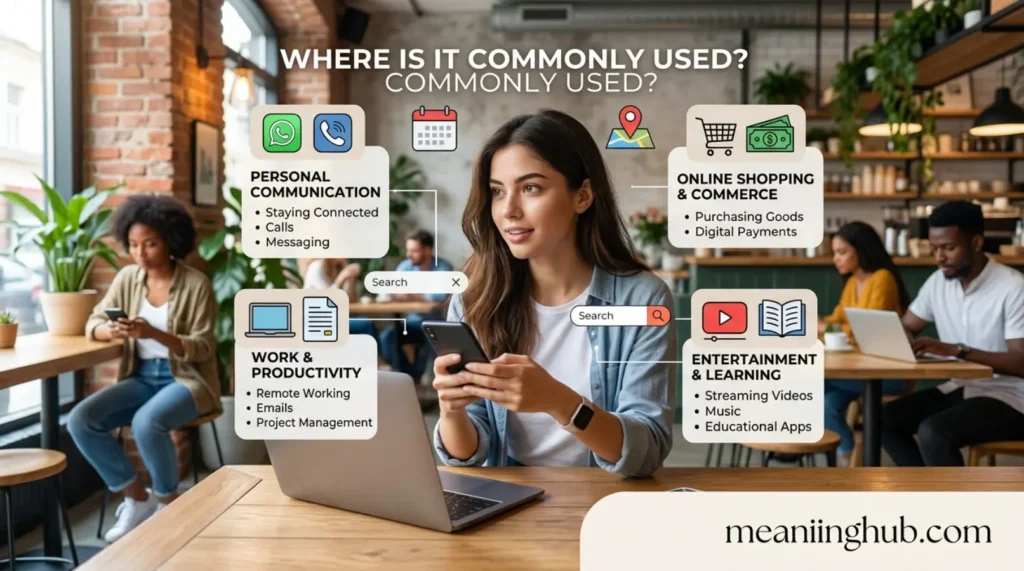
“Uff” is widely used in digital communication, especially among young people.
Common platforms include:
- WhatsApp chats
- Instagram captions and comments
- TikTok reactions
- Snapchat messages
- Online gaming chats
- Facebook comments
It is also popular in South Asian texting culture and is often used in both English and regional language conversations.
Real-life examples of usage
Here are different ways “uff” is used in everyday texting:
1. Friendly conversation
- A: “How was your exam?”
- B: “Uff, it was harder than I expected!”
2. Casual chat
- “Uff, I need a break from work.”
3. Emotional reaction
- “Uff, that ending was so sad.”
4. Excitement or admiration
- “Uff, you look amazing in that outfit!”
5. Stress or frustration
- “Uff, traffic is terrible today.”
These examples show how flexible the slang is depending on emotion.
Origin and background of the slang
The word “uff” comes from natural human expression. People across different cultures make similar sounds when they are:
- Tired
- Relieved
- Shocked
- Emotionally overwhelmed
Over time, this sound became part of informal writing, especially in digital communication. With the rise of texting apps and social media, short emotional expressions like “uff,” “ugh,” and “wow” became popular shortcuts for expressing feelings quickly.
Unlike formal words, “uff” does not come from a specific language or dictionary—it evolved naturally from spoken emotion.
Comparison with similar slang
Here is how “uff” compares with other similar expressions:
| Slang | Meaning | Tone | Usage Context |
|---|---|---|---|
| uff | Relief, exhaustion, emotion | Neutral to emotional | General reactions |
| ugh | Frustration or annoyance | Negative | Dislike or irritation |
| hmm | Thinking or confusion | Neutral | Decision-making or doubt |
| wow | Surprise or admiration | Positive | Impressed reactions |
While “uff” is more emotional and flexible, other slang terms have more specific meanings.
When to avoid using it
Even though “uff” is harmless, there are situations where it may not be appropriate:
- Formal emails or professional communication
- Academic writing or assignments
- Business messages
- Official reports
In these cases, it is better to use full sentences like:
- “I am feeling tired.”
- “That situation was stressful.”
Slang like “uff” is best reserved for casual conversations only.
Polite alternatives
If you want to express the same feeling in a more formal way, you can use:
- “I feel exhausted.”
- “That was a relief.”
- “I am really stressed right now.”
- “That was impressive.”
These alternatives are more suitable for professional or respectful communication.
Why people use this slang
People use “uff” because it is:
- Quick and easy to type
- Emotionally expressive
- Universally understood in informal chats
- Time-saving compared to full sentences
- Natural in tone
In digital communication, speed and emotion matter more than grammar, which is why slang like “uff” is so popular.
Impact of using slang in communication
Slang like “uff” changes the way people communicate online:
Positive impact:
- Makes conversations more natural
- Helps express emotions quickly
- Builds informal connection between users
Negative impact:
- May reduce clarity in serious discussions
- Can seem unprofessional in formal settings
- Might be misunderstood in some contexts
Overall, it improves casual communication but should be used wisely.
Is it safe for social media?
Yes, “uff” is completely safe for social media use. It is not offensive, abusive, or harmful. It is widely used in:
- Captions
- Comments
- Stories
- Reactions
However, tone matters. A harmless word can still feel different depending on how it is used in a sentence.
FAQs
1. What does uff mean in text messages?
“Uff” is an expression used to show emotions like relief, frustration, tiredness, or admiration in casual chats.
2. Is uff a real word?
No, it is not a formal dictionary word. It is a slang expression based on natural human sound.
3. Is uff rude or offensive?
No, “uff” is generally neutral and not considered rude or offensive.
4. Can I use uff in professional messages?
It is not recommended. It is best used in informal conversations only.
5. What is the difference between uff and ugh?
“Uff” shows mixed emotions like relief or exhaustion, while “ugh” usually shows irritation or dislike.
6. Why do people use uff in chats?
People use it because it is short, expressive, and quickly conveys emotion without writing long sentences.
Conclusion
The uff meaning in text is simple yet powerful. It is an informal expression used to show emotions such as relief, stress, exhaustion, or admiration. While it has no fixed definition or full form, its meaning depends on context and tone.
In casual communication, “uff” helps people express feelings quickly and naturally. However, it should be avoided in formal or professional settings where clear and proper language is required

Alexander Ford is a passionate writer who specializes in modern text slang, internet culture, and digital communication trends. He is known for his simple, engaging, and reader-friendly writing style that makes online language easy to understand. With a love for research and creativity, Alexander enjoys helping readers stay updated with the latest social media expressions and texting terms.