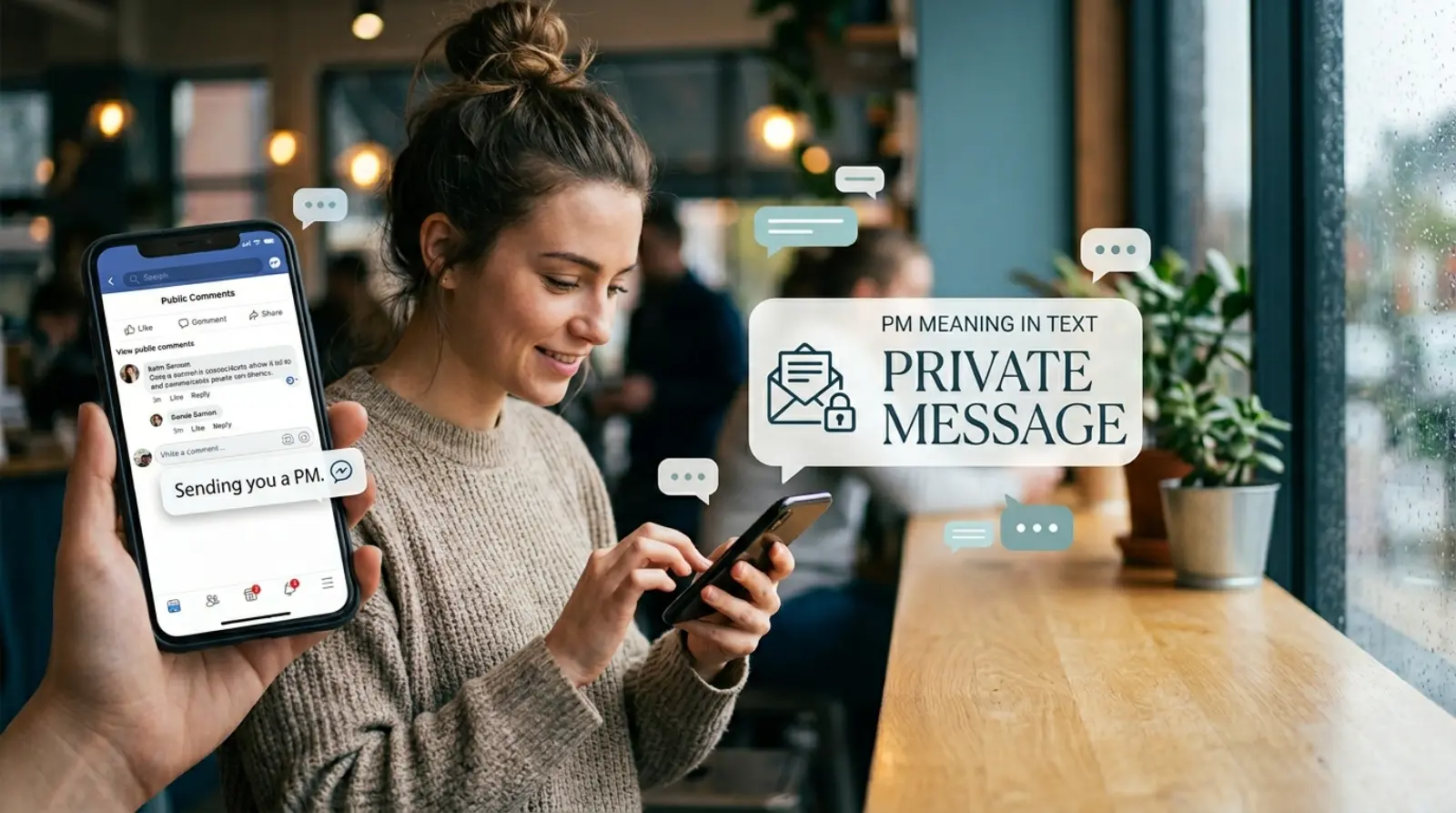
PM meaning in text is one of the most commonly searched chat abbreviations online. Whether you’re scrolling through social media, chatting with friends, gaming, or participating in online communities, you’ve probably seen someone write “PM me” or simply “PM.”
Many people get confused because PM can have more than one meaning depending on the context. In most text conversations, PM refers to a private message sent directly to another person. However, in some situations, PM can also refer to a specific time of day.
Understanding the meaning of PM helps you communicate more effectively and avoid misunderstandings in online conversations.
Quick Answer
PM meaning in text usually stands for “Private Message.” It refers to a direct message sent privately between two people instead of posting publicly in a group, forum, or social media comment section.
What Does PM Mean in Text?
The abbreviation PM most commonly means Private Message in texting, social media, forums, and online communities.
When someone says:
- “PM me the details.”
- “Send me a PM.”
- “I’ll PM you later.”
They are asking for or offering a private conversation that others cannot see.
Private messages are commonly used when people want to:
- Share personal information
- Discuss sensitive topics
- Exchange contact details
- Continue a conversation privately
- Avoid cluttering public comment sections
PM Full Form
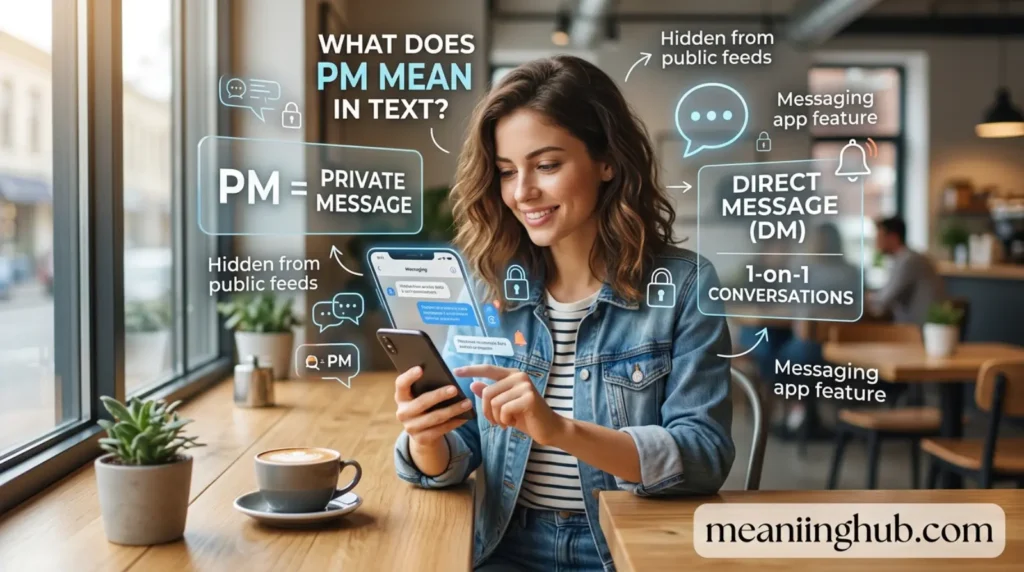
The PM full form in texting is:
PM = Private Message
In some contexts, PM can also mean:
| PM Meaning | Context |
|---|---|
| Private Message | Texting, social media, forums |
| Post Meridiem | Time after noon (12 PM–11:59 PM) |
| Project Manager | Workplace communication |
| Prime Minister | Political discussions |
When discussing texting slang, Private Message is the meaning people usually intend.
What Does PM Stand For in Online Chats?
When users ask, “What does PM stand for?”, the answer depends on context.
Examples:
Social Media
“PM me for pricing.”
Meaning: Send a private message to receive pricing information.
Online Marketplace
“Interested buyers should PM me.”
Meaning: Contact the seller privately.
Gaming Communities
“PM me your username.”
Meaning: Send your username in a private message.
Is PM Rude, Offensive, or Neutral?
PM is completely neutral.
It is a polite and widely accepted abbreviation used by people of all ages.
Tone Analysis
| Situation | Tone |
|---|---|
| PM me the details | Neutral |
| Please PM me | Polite |
| PM me ASAP | Slightly urgent |
| Don’t PM me again | Negative |
The abbreviation itself is not rude. The tone depends on the overall message.
Where Is PM Commonly Used?
PM appears on many digital platforms.
Social Media
People use PM on:
- X (Twitter)
- TikTok
Example:
“PM me if you’re interested.”
Online Forums
Forum users often write:
- PM sent.
- Check your PMs.
- I’ll PM you later.
Gaming Platforms
Gamers frequently use PM to:
- Share team information
- Exchange game IDs
- Coordinate strategies
Marketplace Apps
Sellers and buyers use PM for:
- Negotiating prices
- Sharing payment details
- Arranging delivery
Real-Life Examples of PM Usage
Here are some practical examples.
Friendly Example
“Hey, PM me your new phone number.”
Casual Example
“I’ll PM you the restaurant address.”
Professional Example
“Please PM me your email address so I can send the document.”
Marketplace Example
“PM me if you want to purchase this item.”
Community Example
“Thanks for your comment. I’ll PM you the details.”
Origin and Background of PM
The term PM became popular during the early days of internet forums and chat rooms.
Before modern social media platforms existed, forums allowed users to send messages privately through built-in messaging systems.
These messages were called:
- Private Messages (PMs)
- Personal Messages
- Direct Messages (DMs)
As online communication evolved, PM remained a popular abbreviation across many platforms.
Today, younger users often prefer the term DM, but PM is still widely understood.
PM vs DM: What’s the Difference?
Many people wonder whether PM and DM mean the same thing.
The answer is usually yes.
Comparison Table
| Term | Full Form | Meaning |
|---|---|---|
| PM | Private Message | Private communication |
| DM | Direct Message | Private communication |
| IM | Instant Message | Real-time private chat |
| MSG | Message | General communication |
Key Difference
- PM emphasizes privacy.
- DM emphasizes direct communication.
In everyday use, both terms often mean the same thing.
Why Do People Use PM Instead of Writing “Private Message”?
People use abbreviations because they:
- Save time
- Make typing faster
- Fit character limits
- Feel natural in online conversations
- Improve communication efficiency
Instead of writing:
“Please send me a private message.”
People simply write:
“PM me.”
This shorter version is easier and quicker to type.
When Should You Avoid Using PM?
Although PM is common, there are situations where using the full phrase may be better.
Professional Documents
Avoid abbreviations in:
- Contracts
- Reports
- Official letters
Formal Business Communication
Use:
- Private message
- Direct message
Instead of just PM when clarity is important.
When Speaking to Beginners
Not everyone understands internet slang.
Using the complete phrase can prevent confusion.
Polite Alternatives to PM
If you prefer more professional language, consider these alternatives:
| Alternative | Use Case |
|---|---|
| Private Message | General use |
| Direct Message | Social media |
| Contact Me Privately | Professional |
| Send Me a Message | Casual |
| Reach Out Directly | Business |
Examples:
- “Please send me a private message.”
- “Feel free to contact me directly.”
- “You can message me privately.”
Why People Use PM in Modern Communication
PM remains popular because it helps people move conversations away from public spaces.
Benefits include:
Privacy
Sensitive information stays hidden.
Convenience
Conversations become easier to manage.
Security
Personal details are not shared publicly.
Better Organization
Long discussions don’t clutter public comment sections.
Impact of Using Slang Like PM in Communication
Slang abbreviations have changed the way people communicate online.
Positive Effects
- Faster communication
- Better engagement
- Easier texting
- More casual interaction
Negative Effects
- Can confuse new users
- May appear unprofessional in formal settings
- Different meanings can create misunderstandings
Using PM appropriately helps maintain clear communication.
Is PM Safe for Social Media?
Yes, PM is generally safe to use on social media.
However, users should remain cautious when sharing:
- Home addresses
- Banking information
- Passwords
- Personal identification details
A private message offers privacy but does not guarantee complete security.
Always use trusted platforms and practice safe online communication.
Examples of PM in Different Contexts
Friendly Conversation
Friend: “Can I get your vacation photos?”
You: “Sure, I’ll PM them to you.”
Casual Social Media Post
“PM me if you want the link.”
Argumentative Context
“If you have an issue, PM me instead of arguing publicly.”
Gaming Context
“PM me your gamer tag so we can join the same squad.”
Business Context
“Please PM your email address for further information.”
Common Misunderstandings About PM
PM Always Means Private Message
Not always.
In time-related discussions:
- 8 PM means eight o’clock in the evening.
PM and DM Are Different
In most social media contexts, they are nearly identical.
PM Is Old Slang
While DM is becoming more common, PM is still widely used worldwide.
Frequently Asked Questions
What is the PM meaning in text?
PM usually means Private Message, a message sent directly and privately to another person.
What does PM stand for?
PM stands for Private Message in texting and online communication.
Is PM the same as DM?
Yes. In most online conversations, PM and DM both refer to private communication between users.
Is PM rude?
No. PM is a neutral and widely accepted abbreviation.
Can PM mean something other than Private Message?
Yes. Depending on context, PM can also mean Post Meridiem, Project Manager, or Prime Minister.
Should I use PM in professional communication?
It’s better to use “private message” in formal communication for maximum clarity.
Conclusion
Understanding PM meaning in text helps you communicate more confidently across social media, forums, gaming platforms, and messaging apps. In most situations, PM stands for Private Message, which refers to a direct conversation that remains hidden from public view.
The abbreviation is neutral, widely accepted, and easy to use. Whether someone says “PM me the details” or “I’ll send you a PM,” they are simply referring to a private conversation.
As with all internet slang, context matters. Knowing when and where to use PM can improve communication, reduce misunderstandings, and help you navigate online conversations more effectively.

Emily Johin is a passionate writer who enjoys creating simple, engaging, and reader-friendly content. She specializes in topics like text meanings, online trends, and modern lifestyle ideas. Her writing style is clear, conversational, and designed to connect with everyday readers. Outside of writing, Emily loves reading blogs, exploring new cafés, and discovering fresh creative inspiration.