Pardon Meaning is a common search because the word appears in everyday conversations, legal documents, movies, books, and online messages. Some people hear someone say “Pardon?” in a conversation, while others read about a presidential pardon or legal pardon in the news. Since the word has more than one meaning, it can be confusing to understand the correct usage.
The good news is that pardon is a simple and polite word once you know its different meanings. It can be used to ask someone to repeat what they said, to politely excuse yourself, or to describe official forgiveness for a crime. This guide explains every meaning in clear, easy English with practical examples.
Quick Answer:
Pardon means to forgive someone, excuse someone, or politely ask a person to repeat what they said. Its exact meaning depends on the situation in which it is used.
What Does Pardon Mean?
The word pardon has three main meanings.
- To forgive someone for a mistake or offense.
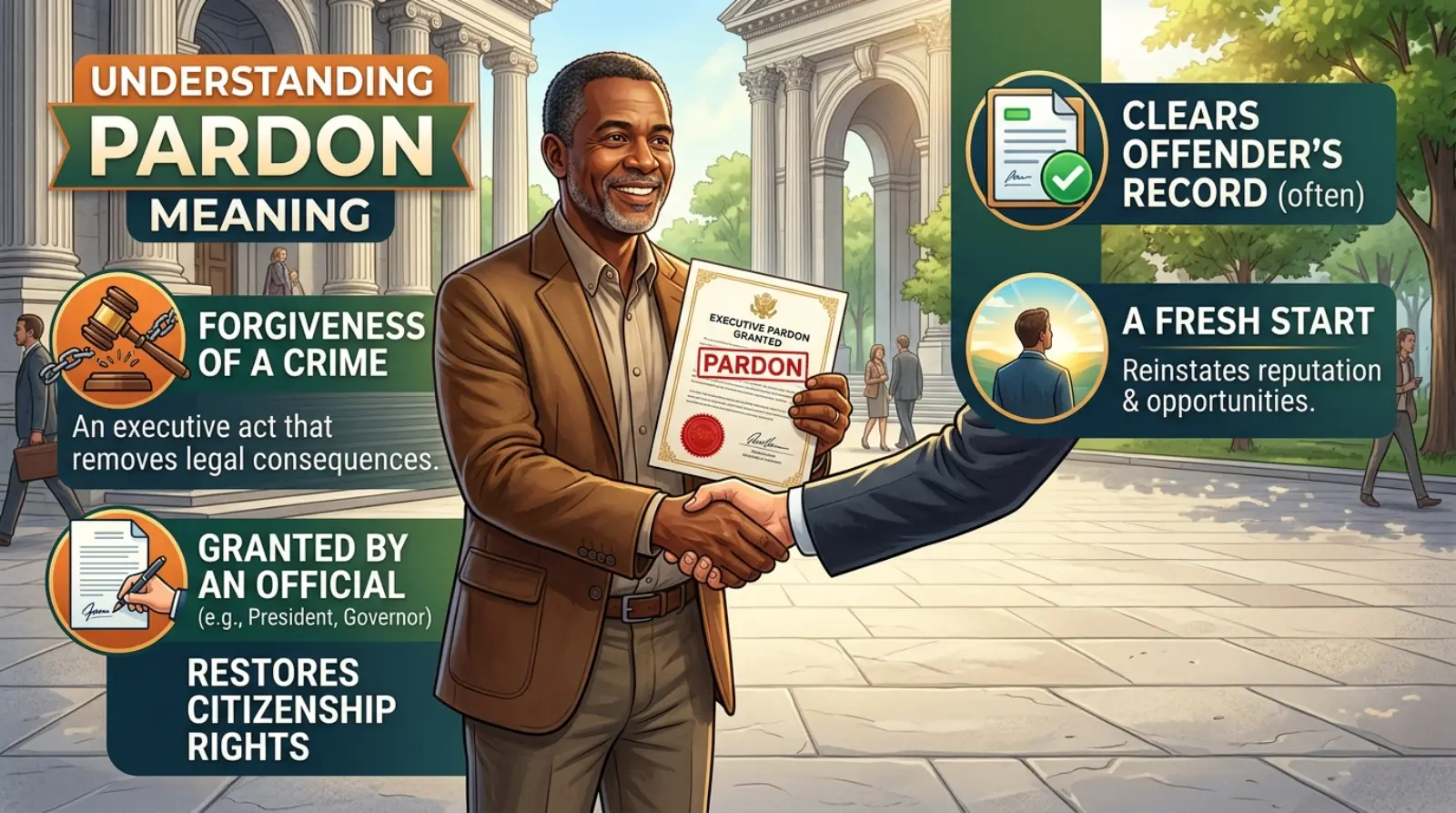
- To officially forgive someone for a crime.
- To politely ask someone to repeat what they said.
Simple Definition
Pardon is both a noun and a verb.
Pardon Full Form
Unlike internet abbreviations or text slang, pardon does not have a full form. It is a complete English word that has been used for hundreds of years.
People sometimes search for:
- Pardon full form
- What does pardon stand for
The answer is simple.
Pardon is not an acronym. It has no expanded form.
Pardon Meaning in Different Situations
Pardon in Everyday Conversation
In daily life, pardon is often used to politely ask someone to repeat something.
Example:
Person A: “I’ll meet you at seven.”
Person B: “Pardon?”
This simply means, “Could you say that again?”
Pardon as Forgiveness
Pardon can also mean forgiving someone’s mistake.
Example:
“I hope you can pardon my late arrival.”
Here, the speaker is asking for forgiveness.
Pardon in Law
In legal language, a pardon is an official decision that forgives someone for a crime.
Example:
“The governor granted the prisoner a pardon.”
This meaning is common in news reports and legal discussions.
Is Pardon Rude, Offensive, or Neutral?
Pardon is considered a neutral and polite word.
It is often more formal than saying:
- Sorry?
- What?
- Come again?
Many people use pardon because it sounds respectful.
Formality Level
| Expression | Formality | Politeness |
|---|---|---|
| Pardon | High | Very Polite |
| Excuse me | High | Very Polite |
| Sorry? | Medium | Polite |
| What? | Low | Can sound rude |
Where Is Pardon Commonly Used?
You may hear or read pardon in many places.
Daily Conversations
People use it when they do not hear someone clearly.
Example:
“Pardon, I didn’t catch that.”
Schools
Teachers and students sometimes use it in formal conversations.
Example:
“Pardon me, may I ask a question?”
Business Communication
Employees may use pardon during meetings.
Example:
“Pardon, could you repeat the last point?”
Legal Documents
Lawyers, judges, and government officials use pardon when discussing criminal forgiveness.
Books and Movies
Many English novels and films include the phrase “Pardon me.”
Real-Life Examples of Pardon
Friendly Conversation
“Pardon, I missed what you said.”
Casual Conversation
“Pardon? The music is too loud.”
At Work
“Pardon me for interrupting the meeting.”
Classroom
“Pardon, could you explain this chapter again?”
Restaurant
“Pardon me, could we have the menu?”
Legal Example
“The president issued a pardon to the prisoner.”
Origin and History of Pardon
The word pardon comes from the Old French word pardoner, which means to forgive.
Its roots go back to the Latin language, where similar words referred to granting forgiveness or mercy.
English speakers have used pardon since the Middle Ages, making it one of the oldest words related to forgiveness.
Although its meaning has expanded over time, the central idea of forgiveness and politeness has remained the same.
Comparison with Similar Words
| Word | Meaning | Common Use |
|---|---|---|
| Pardon | Forgive or repeat | Everyday and legal English |
| Excuse me | Get attention or apologize | Public situations |
| Sorry | Apology or repeat request | Informal conversations |
| Forgive | Stop feeling angry | Personal relationships |
| Mercy | Compassion or kindness | Legal and religious contexts |
Pardon vs Excuse Me
Many English learners wonder about the difference.
Pardon
Usually asks someone to repeat what they said.
Example:
“Pardon?”
Excuse Me
Used to politely interrupt or get attention.
Example:
“Excuse me, where is the station?”
Pardon vs Sorry
Both can ask for repetition.
Example:
“Pardon?”
“Sorry?”
The main difference is tone.
- Pardon sounds more formal.
- Sorry sounds more casual.
When Should You Avoid Using Pardon?
Although pardon is polite, there are situations where another phrase may sound more natural.
Avoid using it:
- When texting close friends who normally use casual language.
- In very informal online chats where “sorry?” is more common.
- Repeatedly during one conversation, as it may interrupt the flow.
Instead, you can say:
- Could you repeat that?
- I didn’t hear you.
- Could you say that again?
Polite Alternatives to Pardon
Here are some excellent alternatives.
- Excuse me.
- Sorry, I didn’t hear you.
- Could you repeat that?
- Would you mind saying that again?
- I beg your pardon.
- Could you please explain?
These alternatives are useful in both personal and professional settings.
Why Do People Use Pardon?
People choose pardon because it sounds respectful and professional.
Some common reasons include:
- Showing good manners.
- Asking politely for clarification.
- Speaking formally.
- Expressing forgiveness.
- Using respectful English in professional settings.
Impact of Using Pardon in Communication
Using polite words helps create positive conversations.
Benefits include:
- Better communication.
- Fewer misunderstandings.
- More respectful discussions.
- Professional image.
- Positive first impressions.
Simple words like pardon can make conversations smoother and more pleasant.
Is Pardon Safe for Social Media?
Yes.
Pardon is completely safe for:
- X
- TikTok
- Snapchat
- Discord
It is not offensive, vulgar, or inappropriate.
Many users simply type:
- Pardon?
- Pardon me.
- Beg your pardon.
These expressions are considered polite in online conversations.
Examples of Pardon in Different Situations
Friendly
“Pardon, I couldn’t hear you over the music.”
Casual
“Pardon? Can you say that one more time?”
Professional
“Pardon me, I have one question before we continue.”
Argument
“Pardon? I never said that.”
Gaming
“Pardon, your microphone cut out.”
Social Media
“Pardon? Did I read that correctly?”
Family
“Pardon me for being late.”
Customer Service
“Pardon, could you help me find this product?”
Common Mistakes People Make
Many learners confuse the different meanings of pardon.
Mistake One
Thinking it only means forgiveness.
Actually, it also means asking someone to repeat themselves.
Mistake Two
Believing it is old-fashioned.
Although slightly formal, millions of English speakers still use it today.
Mistake Three
Using it as slang.
Pardon is a standard English word, not internet slang.
Tips for Using Pardon Correctly
- Use it politely.
- Match the tone of the conversation.
- Use it professionally when needed.
- Understand the context before choosing the meaning.
- Remember that legal pardon and conversational pardon are different.
FAQs
What does pardon mean?
Pardon means to forgive someone, excuse someone, or politely ask a person to repeat what they said.
Is pardon a slang word?
No. Pardon is a standard English word that has existed for centuries.
What is the full form of pardon?
Pardon has no full form because it is not an abbreviation or acronym.
Is saying pardon polite?
Yes. It is one of the most polite ways to ask someone to repeat themselves.
What is a legal pardon?
A legal pardon is official forgiveness granted by a government authority for a criminal offense.
Can I use pardon in text messages?
Yes. Although many people simply use “Sorry?” in texts, “Pardon?” is perfectly acceptable and polite.
Conclusion
Pardon Meaning is easy to understand once you know its different uses. The word can mean forgiveness, official legal mercy, or a polite request for someone to repeat what they said. Its meaning always depends on the context.
Because pardon is respectful, professional, and widely accepted, it remains a valuable word in everyday English. Knowing when to use it will help you communicate more clearly, sound more polite, and avoid misunderstandings in both spoken and written conversations.

Alexander Ford is a passionate writer who specializes in modern text slang, internet culture, and digital communication trends. He is known for his simple, engaging, and reader-friendly writing style that makes online language easy to understand. With a love for research and creativity, Alexander enjoys helping readers stay updated with the latest social media expressions and texting terms.