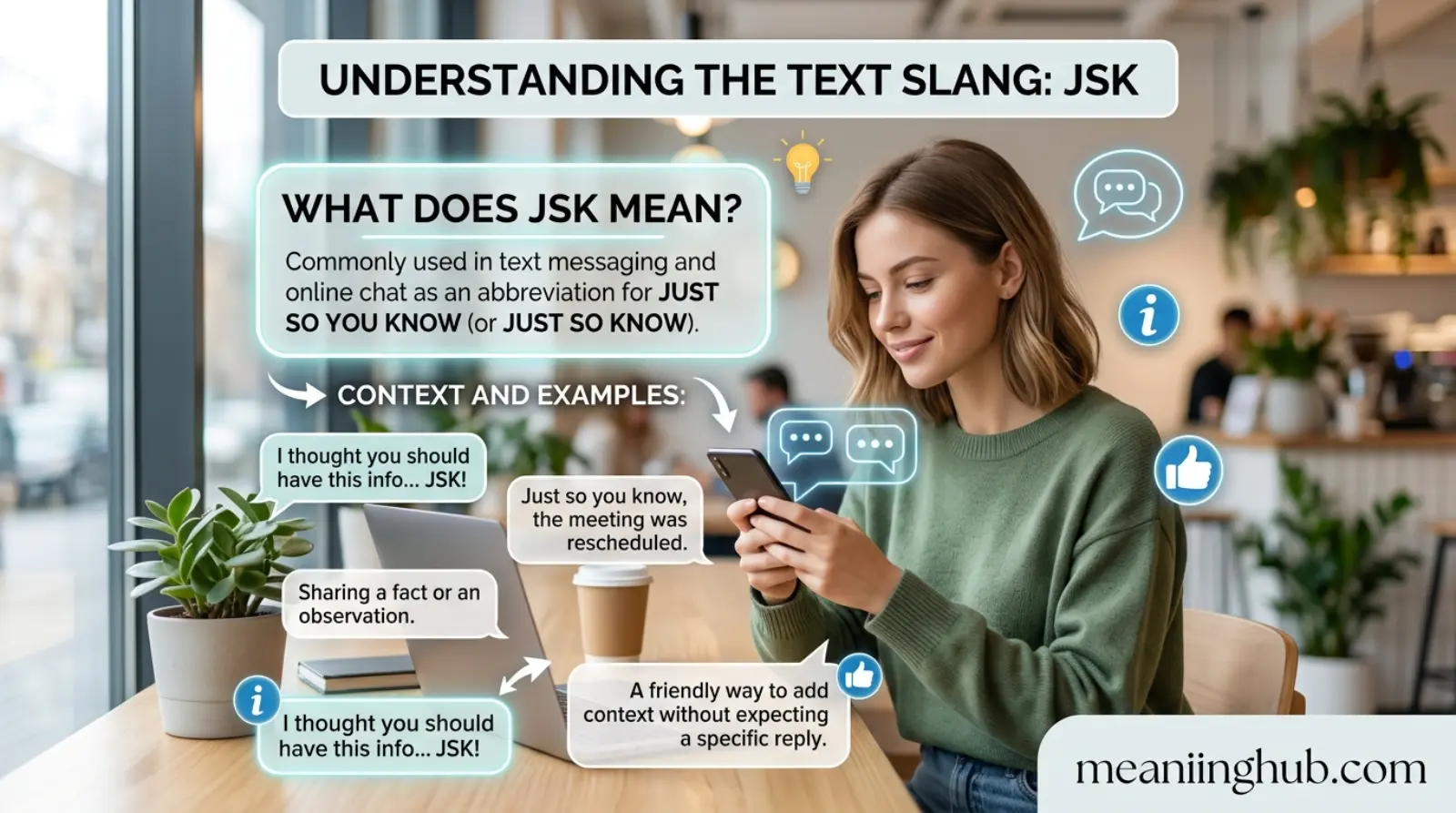
The slang jsk meaning in text is something many people come across while chatting on WhatsApp, Instagram, Snapchat, or even gaming platforms. As online communication grows, new abbreviations like JSK are becoming common, but their meanings are not always clear. That’s why users often search for what JSK actually stands for and how it is used in real conversations.
In most cases, JSK is used as a short form in casual messaging and can have different meanings depending on the context and region. It can be playful, cultural, or simply conversational, which makes it even more confusing for new users.
Quick Answer:
JSK in text usually means “Just Kidding” in casual chats, but it can also mean “Jai Shree Krishna” in cultural or religious contexts.
What does jsk meaning in text ?
The phrase JSK meaning in text refers to understanding the abbreviation “JSK” used in online conversations. Like many internet slang terms, its meaning depends heavily on the situation and the people using it.
Most commonly, JSK is used as:
- A casual way to say “Just Kidding”
- A cultural greeting in some communities: “Jai Shree Krishna”
So, when someone uses JSK in a message, you must look at the context before assuming its meaning.
Full form / definition of JSK in texting
JSK does not have a single fixed meaning. Instead, it has multiple interpretations:
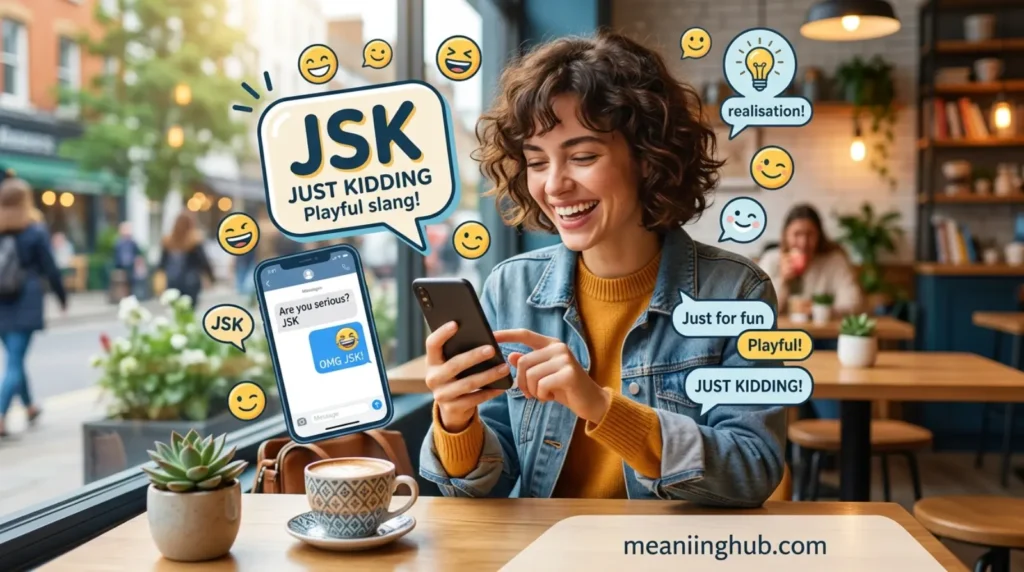
1. Just Kidding (Most Common Meaning)
Used when someone is joking after saying something serious or funny.
Example:
- “You failed the test 😆 JSK!”
2. Jai Shree Krishna (Cultural Meaning)
Used in India and among Hindu communities as a greeting or spiritual expression.
Example:
- “Good morning! JSK 🙏”
3. Less Common Interpretations
In rare cases, JSK may also appear as a personal abbreviation or brand-related shorthand, but these are not widely used in texting slang.
Is JSK rude, offensive, or neutral?
JSK is generally neutral and harmless, but tone matters:
- ✔ Friendly when used as “Just Kidding”
- ✔ Respectful when used as “Jai Shree Krishna”
- ❌ Not offensive in normal usage
- ⚠ Can be confusing if the receiver misunderstands context
So overall, JSK is safe to use in casual conversations.
Where is JSK commonly used?
The slang JSK meaning in text appears in several online spaces:
- WhatsApp chats
- Instagram comments and DMs
- Snapchat streak conversations
- Facebook posts
- Gaming chats
- Religious or cultural messaging groups
It is especially common among teenagers and young adults who prefer short forms while texting.
Real-life examples of JSK usage
Friendly conversation
- A: “I think you forgot my birthday 😏”
- B: “No way! JSK, I was planning a surprise!”
Casual chat
- “You are the worst player in the team 😂 JSK bro!”
Cultural greeting
- “JSK 🙏 Hope you have a blessed day”
Social media comment
- “This video is too funny JSK 😂😂”
Gaming context
- “You got eliminated so fast JSK 😆”
Origin and background of JSK
The origin of JSK meaning in text comes from two different sources:
- Internet slang evolution
- “Just Kidding” has long been shortened to “JK”
- JSK likely evolved as an extended or stylized version in texting culture
- Cultural influence
- “Jai Shree Krishna” is a traditional Hindu greeting
- It is widely used in India and among global Hindu communities
This dual origin is why JSK has multiple meanings today.
Comparison with similar slang terms
| Slang | Full Form | Meaning | Usage Context |
|---|---|---|---|
| JSK | Just Kidding / Jai Shree Krishna | Joke or greeting | Casual & cultural |
| JK | Just Kidding | Used after joking | Informal chat |
| LOL | Laugh Out Loud | Expressing laughter | Social media & texting |
| BRB | Be Right Back | Temporary leave | Chat & gaming |
| IDC | I Don’t Care | Indifference | Informal tone |
This comparison shows that JSK is more context-sensitive than most slang terms.
When to avoid using JSK
Even though JSK is simple, there are situations where it should be avoided:
- Formal emails or professional messages
- Academic writing
- Serious conversations
- When the meaning might confuse the reader
- Cross-cultural chats where the meaning is unclear
In such cases, it’s better to use full forms instead of slang.
Polite alternatives to JSK
If you want to avoid confusion, you can use:
- “Just kidding”
- “I’m joking”
- “No offense meant”
- “Jai Shree Krishna” (for respectful greetings)
- “Haha, I was joking”
These alternatives are clearer and more universally understood.
Why people use JSK in texting
People prefer JSK meaning in text slang because:
- It saves time while typing
- It makes chats feel casual and friendly
- It adds humor or emotion
- It reflects cultural identity
- It fits modern fast-paced messaging style
Slang like JSK helps make conversations more expressive and engaging.
Impact of using JSK in communication
JSK affects communication in both positive and neutral ways:
Positive impact:
- Makes conversations fun and lighthearted
- Builds cultural connection (Jai Shree Krishna usage)
- Reduces message length
Neutral impact:
- May confuse people unfamiliar with slang
- Requires context for correct interpretation
Overall, it improves informal digital communication when used correctly.
Is JSK safe for social media?
Yes, JSK is completely safe to use on social media platforms:
- No offensive meaning
- No harmful content
- Suitable for public posts and private chats
However, always ensure your audience understands the context to avoid misunderstandings.
FAQs
1. What does JSK stand for in chat?
JSK usually stands for “Just Kidding,” but it can also mean “Jai Shree Krishna” depending on context.
2. Is JSK and JK the same?
Not exactly. JK only means “Just Kidding,” while JSK can have multiple meanings.
3. Is JSK a religious term?
Yes, in many cases JSK is used as “Jai Shree Krishna,” a Hindu greeting.
4. Can I use JSK in formal messages?
No, it is best to avoid slang like JSK in professional or formal communication.
5. Is JSK offensive?
No, JSK is generally neutral and not offensive.
6. Why do people write JSK instead of full words?
Because it is faster, easier, and fits casual online chatting style.
Conclusion
Understanding jsk meaning in text is important because it helps you avoid confusion in digital conversations. JSK can mean “Just Kidding” in casual chats or “Jai Shree Krishna” in cultural contexts. The meaning depends entirely on how and where it is used.
In everyday texting, it adds humor, emotion, and simplicity to conversations. However, always consider context before using it to ensure clear communication. When used properly, JSK is a friendly and expressive part of modern online language.

Emily Johin is a passionate writer who enjoys creating simple, engaging, and reader-friendly content. She specializes in topics like text meanings, online trends, and modern lifestyle ideas. Her writing style is clear, conversational, and designed to connect with everyday readers. Outside of writing, Emily loves reading blogs, exploring new cafés, and discovering fresh creative inspiration.